





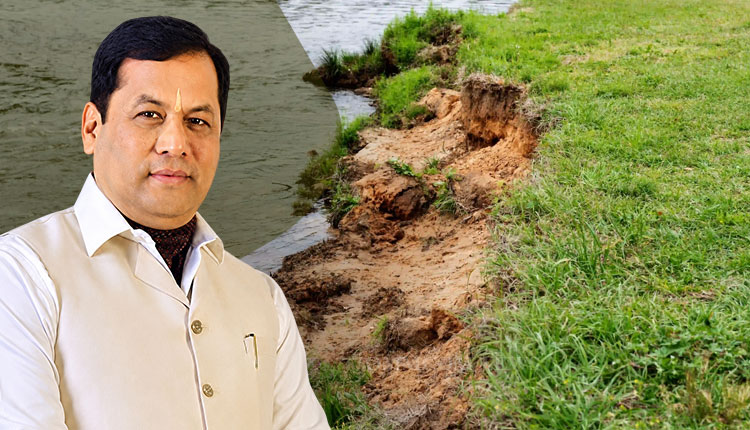
Bhubaneswar: Nearly 28.3 per cent of Odisha’s 564.14-km coastline is currently affected by coastal erosion, Union Minister for Ports, Shipping and Waterways Sarbananda Sonowal informed the Rajya Sabha on Tuesday.
In a written reply to a question by BJD Rajya Sabha MP Sasmit Patra, Sonowal said a comprehensive shoreline change assessment carried out by the National Centre for Coastal Research (NCCR) under the Ministry of Earth Sciences for the period 1990–2022 found that while 54.1 per cent of Odisha’s coastline is witnessing accretion (land gain), 17.6 per cent remains stable and 28.3 per cent is under erosion.
Among the coastal districts, Jagatsinghpur has emerged as the most erosion-prone, with 47.6 per cent of its coastline affected. It is followed by Ganjam (45.7 per cent) and Kendrapada (45 per cent). Baleshwar has reported 23.8 per cent erosion, while 10.2 per cent of Puri’s coastline is under erosion. Bhadrak recorded the lowest erosion at 4.6 per cent.
The NCCR has identified several coastal erosion hotspots across the state. These include areas north of Gopalpur Port, Mayurpada and Bhramarakudi in Ganjam district; both sides of the Chilika sea mouth, Keutajanga and the Devi river mouth in Puri district; Kusupur to Sahadabedi and Sahadabedi to Jatadhartanda in Jagatsinghpur district; Hetamundia, Hukitola, Pentha, Satabhaya and Gahirmatha in Kendrapada district; Amarnagar in Bhadrak district; and Bagda, Chaumukh, Narayan Mohanty Padia, and Bindhapadmapur to Talasari in Baleshwar district.
The minister informed the House that all non-major ports in Odisha are being developed under the Public-Private Partnership (PPP) model, with developers responsible for ensuring the safety, sustainability and climate resilience of coastal infrastructure.
He said that before the execution of any port development project, developers must obtain Environmental Clearance (EC) and Coastal Regulation Zone (CRZ) clearance from the Ministry of Environment, Forest and Climate Change or the State Coastal Zone Management Authority. Environmental Impact Assessment (EIA) and Environmental Management Plan (EMP) studies are mandatory to assess and mitigate environmental impacts.
Sonowal also said that the Ministry of Ports, Shipping and Waterways has issued dredging guidelines for major ports, including Paradip Port, to promote the sustainable use of dredged material and strengthen coastal infrastructure.