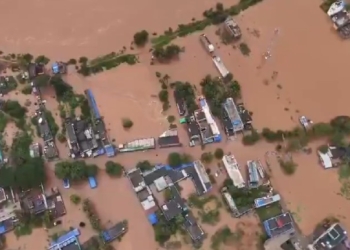






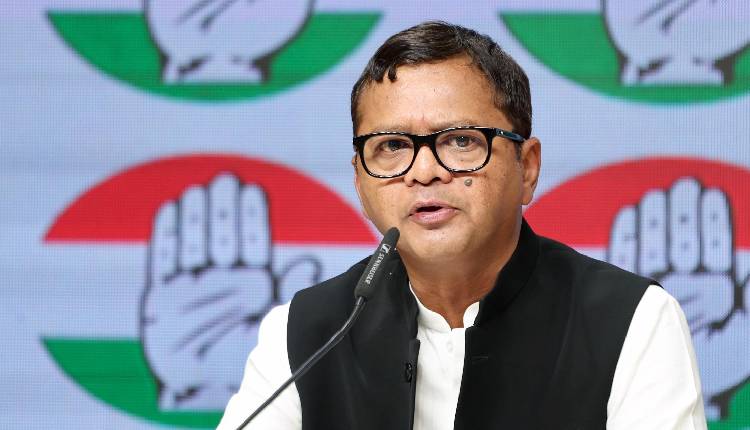
Koraput: Koraput MP Saptagiri Sankar Ulaka has urged Prime Minister Narendra Modi to intervene and provide a special financial assistance package for cyclone-affected areas of Southern Odisha, seeking the deployment of an Inter-Ministerial Central Team (IMCT) to assess the damage caused by Cyclone ‘Arnab’ and subsequent heavy rainfall and flash floods in Koraput and Rayagada districts.
In a letter to the Prime Minister dated October 30, Ulaka highlighted the vulnerability of the tribal-dominated region, citing damage to agricultural lands, rural roads, essential infrastructure and remote hill settlements.
He called for urgent Central assistance for relief, rehabilitation and long-term disaster mitigation measures.
According to rainfall observations cited in the letter, Pottangi recorded 188 mm of rainfall, while Semiliguda received 143.1 mm. Several areas have reportedly experienced waterlogging, falling trees, landslide risks and disruption of road connectivity.
The MP said a comprehensive block-wise assessment was necessary to determine the full extent of the damage in vulnerable areas, including Pottangi, Semiliguda, Nandapur, Lamtaput, Narayanpatna, Bandhugaon and Laxmipur in Koraput district, and Kalyansinghpur, Kashipur, Bissamcuttack, Muniguda, Chandrapur, Gudari and Gunupur in Rayagada district.
Ulaka urged the Centre to depute an Inter-Ministerial Central Team to assess losses to houses, agricultural fields, irrigation facilities, roads, bridges, drinking water systems, schools, Anganwadi centres and healthcare infrastructure. He also sought a coordinated State-level mechanism involving various departments to facilitate the assessment.
Seeking financial support under the applicable State Disaster Response Fund (SDRF) and National Disaster Response Fund (NDRF) frameworks, the MP called for priority restoration of damaged roads, bridges, culverts, electricity infrastructure and drinking water facilities.
He particularly emphasised the need to restore connectivity to remote tribal villages and undertake repairs along vulnerable stretches of National Highways 26 and 326, besides major district and rural roads.
Raising concerns over the impact on farmers, Ulaka called for a preliminary crop-loss assessment within 72 hours, followed by detailed verification of agricultural and horticultural losses.
He sought appropriate compensation for farmers affected by damage to paddy, millets, pulses, vegetables, horticultural plantations and other standing crops under applicable disaster-relief provisions, the Pradhan Mantri Fasal Bima Yojana (PMFBY) and other agricultural assistance schemes.
The MP also called for special attention to small and marginal tribal farmers, including eligible tenant and sharecropper cultivators.
Highlighting the geographical vulnerability of Southern Odisha, Ulaka proposed the constitution of a high-level technical task force involving the Ministry of Jal Shakti, Central Water Commission, National Disaster Management Authority, Geological Survey of India and Coalition for Disaster Resilient Infrastructure.
The proposed task force would prepare a comprehensive flood and landslide mitigation plan for the Vansadhara, Nagavali, Kolab and Indravati river basins, incorporating flood forecasting, riverbank protection, slope stabilisation, catchment treatment, drainage improvement and scientifically assessed flood-control measures.
He also sought an emergency technical assessment of damaged roads, bridges and causeways under the Pradhan Mantri Gram Sadak Yojana (PMGSY), along with additional financial support for reconstruction using climate-resilient specifications.
Urging special protection for vulnerable tribal communities, Ulaka called for adequate relief camps, food supplies, safe drinking water, medical teams, sanitation facilities and temporary shelters for affected families.
He stressed that pregnant women, children, elderly persons and people living in geographically isolated villages should receive priority attention during relief and rehabilitation operations.
Beyond immediate relief, the MP sought a dedicated long-term infrastructure resilience programme for Southern Odisha, focusing on all-weather road connectivity, strengthened bridges, early-warning systems, satellite communication and disaster-resilient public infrastructure.
Stating that repeated extreme weather events could undermine progress in agriculture, rural connectivity and tribal development, Ulaka urged the Prime Minister to treat the matter as a priority and ensure close coordination between the Centre and the Odisha Government for relief, rehabilitation and permanent disaster mitigation.