





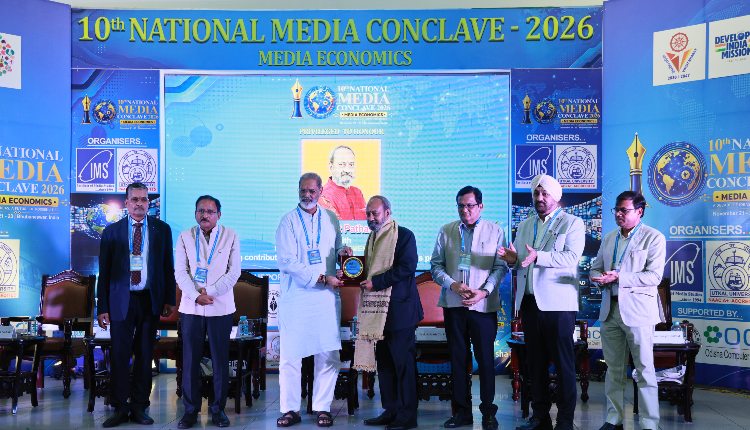
Bhubaneswar: The 10th edition of the National Media Conclave (NMC) commenced on Saturday with an engaging exchange of ideas on the evolving dynamics of media and markets, under the overarching theme ‘Media Economics’. Eminent media professionals, academicians and thought leaders from across the country deliberated on the challenges and opportunities shaping the future of journalism and communication.
Organised by the Institute of Media Studies (IMS), Utkal University, in collaboration with KIIT and OCAC, the three-day national conclave is being held at the KIIT Campus 7 auditorium.
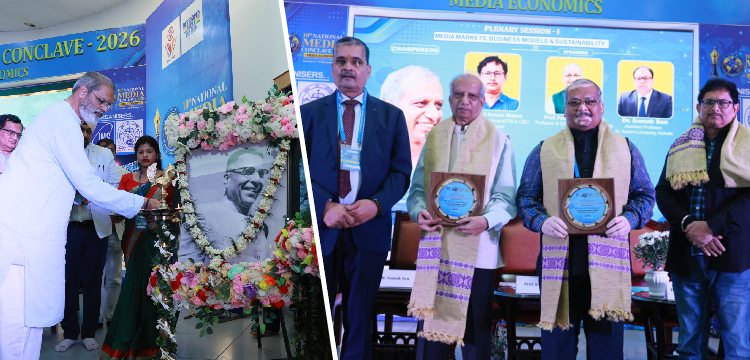
Inaugurating the conclave as Chief Guest, Deputy Chief Minister Kanak Vardhan Singh Deo emphasised the need for a financially sustainable yet credible and independent media. “A democratic media needs to earn enough to remain independent, think deeply enough to remain credible and care enough to make the invisible visible,” he said. Stressing the importance of investigative journalism and balanced reporting, he urged journalists to verify facts, incorporate the perspectives of all stakeholders and refrain from assuming the role of judge, jury and prosecution.
Prof. Saranjit Singh, Vice-Chancellor of KIIT Deemed to be University, highlighted how artificial intelligence and emerging technologies are democratising content production. He noted that storytelling and workflow efficiency, rather than access to sophisticated equipment, would increasingly define competitive advantage in the media industry.
Prof. Avinash Chandra Pandey, Director, Inter-University Accelerator Centre (IUAC), UGC, stressed the importance of deeper cognitive engagement and analytical journalism. He called for responsible reporting backed by expert perspectives and evidence.
Presiding over the inaugural ceremony, Prof. Chandi Prasad Nanda, Vice-Chancellor of Utkal University, observed that media does not merely transmit information but actively shapes the world through narratives. He advocated an interdisciplinary approach to media education integrating economics, history, anthropology, environmental studies, technology and ethics.
Dr. Manoranjan Puthal, Managing Director, Odisha Knowledge Corporation Limited (OKCL), underlined audience engagement as the foundation of media sustainability. “If viewers keep returning to a news platform, only then can it become a sustainable media house. This habit of returning helps newsrooms build audiences and generate revenue to support the next story. That, I believe, is media economics,” he remarked.
Delivering the opening address, Prof. Upendra Padhi, Chairman of NMC and Director of IMS, observed that media economics goes beyond business considerations and is about preparing a future roadmap for journalism.
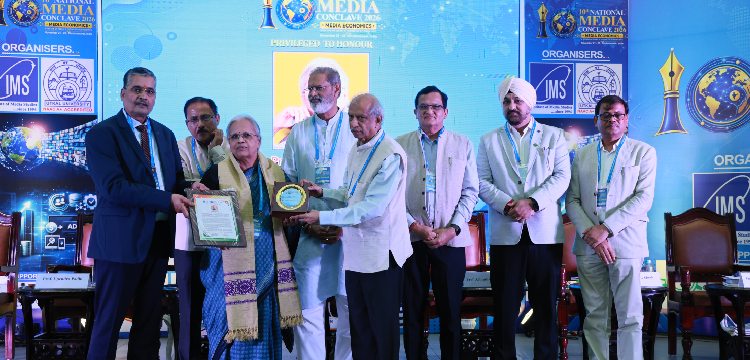
A commemorative volume titled ‘Media Economics’ and the conclave’s abstract booklet were released on the occasion. Prof. Padmaja Shaw, former Professor of Journalism and Mass Communication, Osmania University, and Dr. Ajit Pathak, President of the Public Relations Society of India (PRSI), were conferred with the NMC Lifetime Achievement Award 2026 in recognition of their outstanding contributions to media, communication and public relations. Prof. Shaw also delivered Prof. Sunil Kanta Behera 4th Memorial Lecture on ‘Political Economy of Media and Free Speech’. On first day, three plenary sessions were also organized on different contemporary themes.
The three-day conclave will continue to provide a national platform for dialogue on the changing economics, ethics and future of the media industry.