





In every household, a little disagreement between husband and wife is quite common. When a husband returns home late after spending time with friends and siblings, it’s natural for a wife to feel upset. But have you ever imagined that Goddess Lakshmi, the divine consort of Lord Jagannath experiences similar emotions.
During the grand Rath Yatra, Lord Jagannath stays away from his abode. He remains busy meeting lakhs of devotees and enjoying time with his siblings at Gundicha Temple, his aunt’s house. In the process, He unknowingly delays his return, leaving Goddess Lakshmi waiting. This very human-like divine emotion comes alive through the beautiful and symbolic ritual of Hera Panchami. On the fifth day of the Rath Yatra, Goddess Lakshmi visits the Gundicha Temple to meet the Lord, who did not take her along during the chariot procession. In a touching display of her displeasure, she symbolically breaks a portion of the Nandighosha chariot, the Lord Jagannath’s majestic Rath before returning to the Srimandir.
Ommcom News gets deep into the unique Hera Panchami ritual which beautifully portrays the celestial drama and the loving fight between the divine couple.
How Hera Panchami Became A Key Part Of Rath Yatra
According to the ancient texts of ‘Ratha Chakada’, King Kapilendra Deb revolutionized the Hera Panchami ritual, transforming it from a simple chanting ceremony to a grand and majestic celebration. Since his reign, this ritual has become an integral part of the Rath Yatra festivities. More importantly, Hera Panchami is considered the ceremonial start of Bahuda Jatra. It is on this day that the chariots are turned south during Dakhina Moda, indicating the deities’ return to the temple.
The ritual also made newspaper history. On July 28, 1888, Utkal Deepika, Odisha’s pioneering vernacular daily, carried the first known article on Hera Panchami. The report is seen as the beginning of organized coverage of Odisha’s cultural traditions.
The Legend Behind Hera Panchami Ritual
Jagannath culture experts say Goddess Mahalakshmi embodies the sentiments of an Odia wife. She is left heartbroken when Lord Jagannath sets out on Rath Yatra with his siblings and leaves her behind in Srimandir. The divine couple’s wedding is observed on Jyeshtha Shukla Ekadashi. Days later, after ‘Chaturthi Snana’ on Jyeshtha Purnima, the deities fall sick. For the next 15 days they remain in Anasara Gruha. After recuperation, the Lord appears in Naba Joubana Besha. But by then, Mahalakshmi’s anguish has grown — the Lord left for his annual sojourn without informing her, mirroring a wife’s longing for her husband.
Jagannath Culture experts further say when four nights pass and the Lord still doesn’t return, Goddess Bimala intervenes. As the Tantric consort of Jagannath and protector of Srimandir, she gives Mahalakshmi Mohana Churna to bring him back soon. Her words to the goddess are, ‘Aou Dukha Na Kara Go Bishnu nka Gharani, Mohechurna Basibhuta Hebe Tha Jani’.”
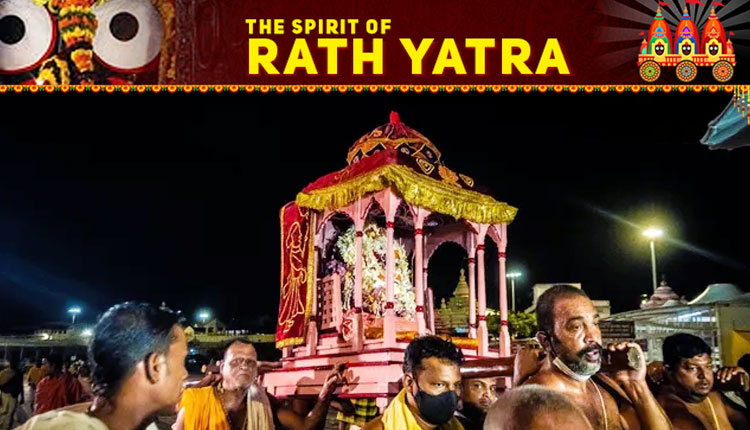
Following Lord Brahma’s counsel, Goddess Mahalakshmi sets out for the Gundicha Temple where Lord Jagannath is staying with his siblings. It was Brahma who once said, “One glimpse of Lord Jagannath at the Adapa Mandap equals a hundred darshans at the Ratna Mandap.” Inspired by these words, Mahalakshmi decides to go and see her husband. In the evening, a grand procession moves down the Bada Danda. Amid chants and celebrations, servitors carry the Goddess in a beautifully decorated palanquin to Gundicha Temple. She enters the Gundicha temple, throws the ‘Mohana Churna’ to attract her husband, and receives a garland of consent (‘Agyan Mala’) on behalf of Lord Jagannath. However, feeling neglected and angry due to her husband’s indifference, she orders her servitors to damage a part of his chariot, seeking to teach him a lesson.
Later, filled with remorse for harming the sacred chariot, she quietly slips away. Abandoning the fanfare, she returns to Srimandir alone through Hera Gohiri Sahi — her pride softened, her anger replaced by regret.
By Rashmi Rekha Das