






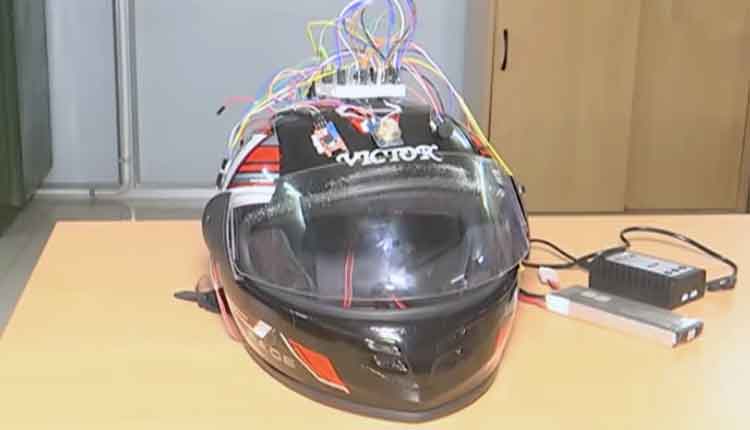
Bhubaneswar: Students of the Computer Science and Engineering department at the National Institute of Technology (NIT) Raurkela have developed a smart helmet that alerts riders about potential collisions and a drone-assisted system that automatically cleans solar panels, offering low-cost technological solutions to improve road safety and renewable energy efficiency.
The two innovations have been developed at the institute’s Intelligent Systems and IoT Research (ISIR) Lab, where students are working on practical technologies to address real-world challenges.
Researchers say the systems have the potential to benefit households, industries and public infrastructure by making transportation safer and improving the performance of solar power installations.
The smart helmet is equipped with three sensors that detect the proximity of nearby vehicles and activate an audible warning siren, enabling riders to react before a possible collision. The device also alerts users while travelling at high speeds, helping reduce accident risks.
According to the research team, the helmet has reached the final stage of development and is expected to undergo field trials before it is taken up for wider deployment.
The students have also developed a drone-assisted solar panel cleaning system that monitors dust accumulation on photovoltaic modules and initiates cleaning automatically. The system uses sensors to analyse dust levels, humidity and temperature before carrying out the cleaning operation.
Researchers said the automated system can significantly reduce dependence on manual cleaning, which is labour-intensive, time-consuming and expensive, particularly at large solar power plants. Regular cleaning also helps maintain the efficiency of solar panels by preventing dust accumulation from reducing energy generation.
The team is now working on further refinements and performance testing before exploring opportunities for technology transfer and commercial deployment.