





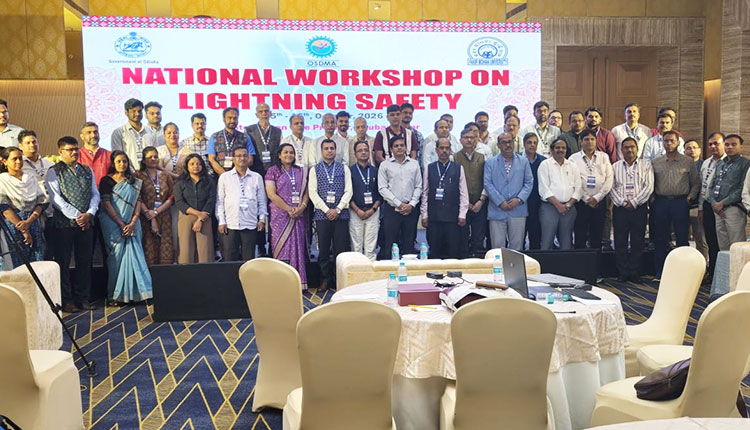
Bhubaneswar: The Odisha State Disaster Management Authority (OSDMA) will prepare a Standard Operating Procedure (SOP) for lightning safety and an action plan for 2027, with a focus on reducing lightning-related fatalities and strengthening emergency response systems, following a two-day national workshop that concluded here on Friday.
The workshop, held at Lemon Tree Premier Hotel, brought together experts, scientists, academicians, medical specialists and disaster management officials to develop an integrated lightning safety strategy for the state. Discussions also focused on an implementation framework for 2027–2030.
Addressing the valedictory session, OSDMA Managing Director Rajesh Prabhakar Patil stressed the need to move beyond demonstrations towards large-scale implementation of lightning safety measures. He highlighted the potential of installing siren systems at the panchayat level to alert people and save lives.
The discussions emphasised timely public warnings, awareness about moving to safe locations during lightning, and prompt medical assistance to those injured by lightning strikes. Farmers, agricultural labourers, students, people working in open fields and rural residents were identified as priority groups for targeted safety measures.
Technical sessions examined international-standard protection systems against lightning and electric shocks, low-cost lightning-safe shelters and technology-based early warning mechanisms.
Associate Professor Dr Sailendra Kumar Mandal of NIT Patna presented the case for sensor-equipped lightning-safe shelters in agriculture-dominated areas. Dr Biswas Chitale of the Council on Energy, Environment and Water (CEEW), Pune, presented a study on lightning safety in Odisha based on Mayurbhanj district.
Dr M.C. Sahu of AIIMS Bhubaneswar and Dr A.B. Jena of FM Medical College and Hospital, Balasore, discussed life-saving first aid and emergency care for lightning-strike victims.
Participants also explored the use of SMS alerts, mobile applications, interactive voice response systems (IVRS), sirens, local announcements and community-based communication networks to disseminate warnings quickly and in simple language.
The workshop called for separate safety guidelines for farmers, school students, outdoor workers and rural communities lacking access to shelters. It also underscored the need for a clear mechanism defining departmental responsibilities, warning levels, emergency response procedures, monitoring and accountability.
Coordination among OSDMA, district administrations, the Meteorological Department, the Health Department, educational institutions and panchayats was identified as crucial for effective implementation.
During the valedictory session, Professor Manoranjan Mishra of Fakir Mohan University presented the workshop’s recommendations and identified 10 priority areas.
The proposed SOP, the 2027 action plan and the implementation framework for 2027–2030 are expected to provide a structured approach to reducing lightning-related risks in Odisha. OSDMA Advisor Dr Kamal Lochan Mishra delivered the vote of thanks.