





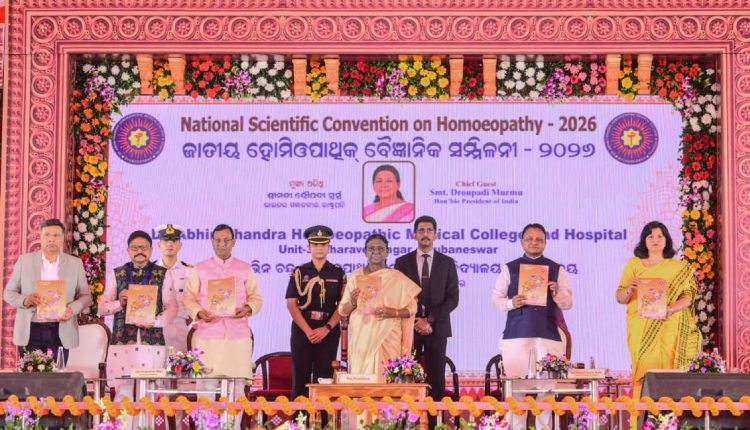
Bhubaneswar: President Droupadi Murmu on Wednesday called upon homoeopathic institutions across the country to embrace emerging scientific and technological developments while retaining compassion, patient dignity and welfare as the guiding principles of healthcare.
Addressing the National Scientific Convention on Homoeopathy-2026 at Dr Abhin Chandra Homoeopathic Medical College and Hospital in Bhubaneswar, the President said rapid advancements in artificial intelligence, digital health technologies, genomics, advanced diagnostics, big data analytics and precision medicine were transforming healthcare and medical education.
She emphasised that homoeopathic institutions must equip themselves to engage with these changes through modern clinical infrastructure, digital health records, research laboratories, interdisciplinary cooperation and contemporary teaching methodologies.
Congratulating students, research scholars, scientists, delegates and experts attending the national convention, Murmu acknowledged India’s progress in developing infrastructure for homoeopathic education, research and clinical practice. She described homoeopathy as an important component of the country’s diverse healthcare landscape.
Stressing the need for scientific accountability, the President said every system of medicine must uphold scientific rigour, evidence-based research and patient safety. She called for continuous evaluation of homoeopathic principles and practices through appropriate scientific methods.
She underlined that research in the discipline should be based on robust methodologies, properly designed clinical studies, systematic documentation and transparent reporting.
The future credibility and academic recognition of homoeopathy, she observed, would depend substantially on the scientific integrity of research and the quality of clinical evidence generated. She urged research institutions, medical colleges, universities and professional organisations to work together towards fostering a strong research culture.
Murmu also highlighted opportunities for cooperation among different medical disciplines in areas such as public health, preventive healthcare, health education, clinical documentation and research, while maintaining due regard for their respective scientific foundations and limitations.
Reiterating the importance of human sensitivity in medical practice, the President said technological progress should never come at the cost of compassion. She stressed that every medical decision must safeguard the dignity, safety and well-being of patients, with the ultimate objective of reducing suffering and improving quality of life.
Addressing young students and researchers, Murmu urged them to become architects of the future of homoeopathy rather than merely inheriting its existing legacy. She encouraged them to cultivate curiosity and lifelong learning, pursue investigations with patience and courage, remain open to new evidence and knowledge, and never lose sight of the hopes, concerns and dignity of patients.
Describing healthcare and education as key pillars of the vision of Viksit Bharat 2047, the President called upon institutions and medical professionals to work towards building an accessible, equitable and scientifically responsible healthcare system.
She also emphasised the need to give priority to healthcare and educational facilities in rural areas, particularly for people who depend heavily on public support for access to medical services and learning opportunities.