


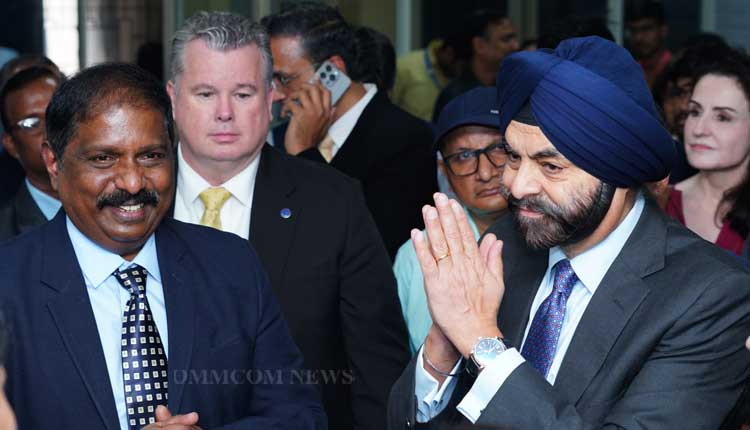
Bhubaneswar: World Bank Group President Ajay Banga on Thursday urged India to shift its focus away from tariff-related anxieties and instead concentrate on unlocking opportunities through trade partnerships, even as geopolitical tensions continue to cloud global commerce.
Speaking to media persons during his visit to the Central Tool Room and Training Centre (CTTC) in Bhubaneswar, Banga highlighted India’s growing engagement with regional and bilateral trade agreements, noting that the country has signed more than 100 such pacts over the past two decades. He cited the recently concluded India–European Union Free Trade Agreement (FTA) as a strong example of this approach.
“Rather than being overly concerned about tariffs, it is important to look at the opportunities created through agreements like the one India has finalised with the European Union,” Banga said, underlining the significance of trade deals in the current global environment.
Emphasising the changing nature of global trade, the World Bank chief pointed out that international trade volumes have increased fourfold over the last 20 years, while the share of emerging economies has doubled from 20 per cent to 40 per cent. This shift, he said, has placed countries like India at the centre of global trade dynamics.
India and the EU recently announced the successful conclusion of negotiations on the long-pending FTA, often referred to as the “mother of all trade deals”. Under the agreement, nearly 93 per cent of Indian exports are expected to receive duty-free access to the 27-member EU bloc, while European luxury automobiles and wines are likely to become more affordable in the Indian market.
The deal, finalised after nearly two decades of discussions, is set to create a combined market of around two billion people, linking the world’s fourth-largest economy, India, with the European Union, the second-largest economic bloc globally.
Banga said the reduction of both tariff and non-tariff barriers by the two sides would deliver mutual benefits. “Lowering these barriers is good for consumers and businesses on both ends,” he observed.
The World Bank President also praised India’s infrastructure push over the past decade, acknowledging visible improvements in airports, roads and other public assets. However, he stressed that further investment remains essential, given the country’s size and diverse economic potential.
According to Banga, India must continue strengthening physical infrastructure, human capital, business-friendly regulations and access to finance for the private sector, particularly micro, small and medium enterprises (MSMEs).
He identified five key sectors with significant employment-generation potential — infrastructure, agriculture, primary healthcare, tourism and value-added manufacturing. Highlighting the importance of rural development, Banga said small farmers need better market access and quality inputs to improve productivity and prosperity.
While acknowledging India’s progress in primary healthcare, he said there was scope to expand high-quality services, which would also create jobs for nurses, diagnostic technicians and midwives, in addition to doctors.
On tourism, Banga noted that despite India’s rich natural landscapes, cultural heritage and cuisine, the country attracts far fewer tourists compared to global cities like New York or Paris. Increasing tourist inflows, he said, represents a major untapped opportunity.
He also underscored the potential of value-added manufacturing, citing institutions such as CTTC-Bhubaneswar as examples of how skill development can support industrial growth.
Reacting to the Economic Survey’s forecast of 6.8 to 7.2 per cent economic growth in 2026–27, Banga said India has consistently demonstrated its capacity for strong growth. However, he emphasised that achieving the vision of “Viksit Bharat” by 2047 would depend largely on large-scale skilling of the youth.
With nearly 12 million young Indians entering the workforce each year, Banga said equipping them with the right skills would open up employment opportunities across cities, villages and even overseas markets.