





New Delhi: An instability persists across the Middle East from Gaza to the Gulf, regional voices are increasingly warning that the real threat is no longer confined to state rivalries, but lies in the growing convergence of terror networks and ideological movements. Amidst this, India is beginning to be seen as a potential balancer.
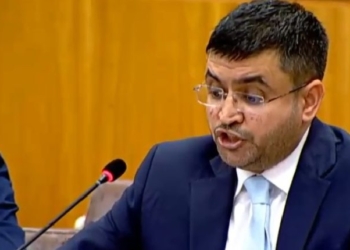
In an interaction titled “Crisis in the Middle East: Are We Entering a New Regional Order?”, Egyptian parliamentarian Mohamed M Farid told think-tank Usanas Foundation CEO, Dr Abhinav Pandya, that India’s role as a constructive partner will be welcomed in the region.
He pointed to the scope of deeper strategic and economic cooperation as the region recalibrates.
The remarks come at a time when governments across West Asia are grappling with a complex security landscape where militant groups, ideological organisations, and geopolitical interests are increasingly intertwined.
While underscoring that the nature of terrorism has changed, Farid said that these groups are not just a regional threat — they are a global threat. He said that these networks must be weakened, but also said that this should be tackled through negotiations.
In the current situation, many countries have been raising concerns about the Muslim Brotherhood. The organisation has been operating through various layers, which also include media outreach, recruitment and a vast network of charities and NGOs. The experts say that it is such a situation that is ongoing in the Middle East that the Muslim Brotherhood thrives on, especially when it comes to radicalisation and recruitment.
Farid says that the organisation thrives on victimhood and uses any vacuum to recruit, especially among the youth. He also pointed to the emergence of parallel networks that operate beyond Egypt, including formation-linked elements that fled the country and continue to run propaganda and organisational activities abroad. These developments have led to fatigue among the population who are caught in never-ending cycles of conflict.
For instance, in Lebanon, there is frustration among the people with Hezbollah for repeatedly dragging the country into wars, he said. The same is the case in Gaza, where the people are tired of Hamas, and younger generations have started to demonstrate against the outfit.
On Iran, Farid said that the regime is influenced by hardline elements, especially the Islamic Revolutionary Guards (IRGC). Their support for proxy actors continues to pose a challenge. He, however, noted that engagement remains essential. Any resolution must address enriched uranium, nuclear capabilities, ballistic missiles, freedom of navigation, and the restraint of proxies, he said.
Since the war in Iran began, India has advocated for peace. It has welcomed ceasefire efforts and hoped for lasting peace in West Asia. However, India has expressed concern over the disruption of trade through the Strait of Hormuz and emphasised the need for free navigation and securing the flow of energy.
India has maintained diplomatic and balanced relations with all key parties, including the US, Israel and Iran.
Experts say that despite all that has been going on, India has positioned itself as a trusted, neutral actor capable of facilitating dialogue.
For India, this evolving landscape presents a clear opportunity, the experts say. They add that by maintaining ties across competing blocs, including those divided over Iran, India has built a reputation as a partner that can engage without escalating tensions, they say. Farid said that India’s growing cooperation with Arab countries, particularly Egypt, could play a significant role in shaping future engagement. He noted that India’s role as a constructive partner will be welcomed, with significant potential for deeper economic and strategic collaboration in the new Middle East in the coming years.
(IANS)