





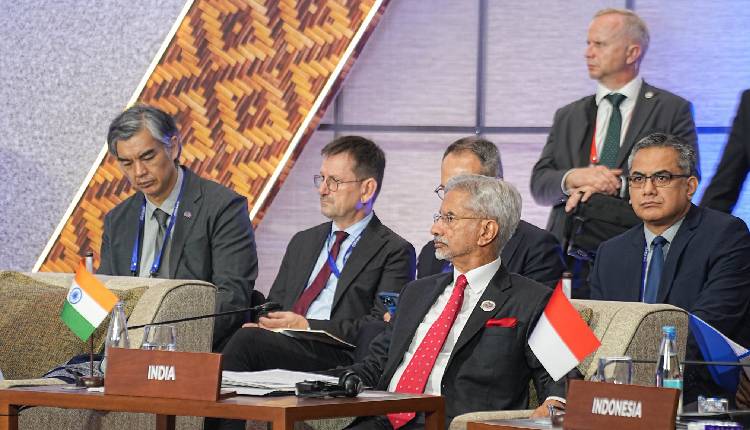
Manila: External Affairs Minister (EAM) S. Jaishankar on Thursday described attacks on merchant shipping and civilian infrastructure as “unacceptable”, stressing that commerce through international waterways must remain safe and free from disruptions.
Addressing the 33rd ASEAN Regional Forum (ARF) Ministerial Meeting in Manila, EAM Jaishankar underscored the forum’s importance for discussing political and security issues in the Indo-Pacific amid global uncertainties.
“Welcomed the Manila Plan of Action and highlighted that its five pillars are aligned with India’s own approach to the Indo-Pacific. India promotes a collaborative approach to disaster relief, sharing best practices, developing common SOPs and undertaking real-time & table top exercises,” EAM posted on X, following the ARF Ministerial Meeting.
“Highlighted that attacks on maritime shipping and civilian infrastructure are unacceptable, and commerce through international waterways should remain safe and unimpeded,” he mentioned.
The EAM also shared that India advocates for the Coalition for Disaster Resilient Infrastructure, regularly deploys field hospitals, provides search and rescue teams, and sends relief materials and medical supplies.
He noted that India has undertaken rehabilitation recently ranging from the cyclone in Sri Lanka, the Philippines and Jamaica to earthquakes in Myanmar, Venezuela and Afghanistan.
Emphasising the need for zero tolerance against terrorism, EAM Jaishankar said there should be no doubt that terrorist acts would have consequences.
He also called for prioritising efforts to choke financing resources that fuel it, adding that India co-chairs the ASEAN Defence Ministers’ Meeting Plus (ADMM +) Experts’ Working Group on Counter-Terrorism with Malaysia and is taking the lead in producing a compendium of best practices.
Underscoring India’s role in ensuring a secure maritime environment, the External Affairs Minister said, “On maritime security, shared that the Information Fusion Centre in India, the Indo-Pacific Maritime Domain Awareness initiative, deployment of Indian forces from the North Arabian Sea to the Western Pacific, are making a valuable contribution to counter piracy, trafficking and narcotics trade as well as secure maritime commerce.”
He further stressed the need for the international community to be “on guard against those who undermine non-proliferation and disarmament.”
EAM Jaishankar also advocated a responsible and human-centric approach on AI and deeper cooperation on cybercrimes and other issues.
Reaffirming India’s support for a legally binding Code of Conduct (COC) in the South China Sea, he said: “On South China Sea, underlined that we look forward to a substantive, effective and legally binding CoC fully compliant with UNCLOS 1982 that does not prejudice the legitimate rights of all users.”
His remarks came amid a recent confrontation between the Philippines and China in the South China Sea.
The South China Sea is one of the world’s busiest maritime trade routes and is claimed in whole or in part by China, the Philippines, Vietnam, Malaysia, Brunei and Taiwan. The competing claims have led to repeated confrontations involving coast guard and naval vessels, making the waterway a major strategic flashpoint in the Indo-Pacific.
(IANS)