


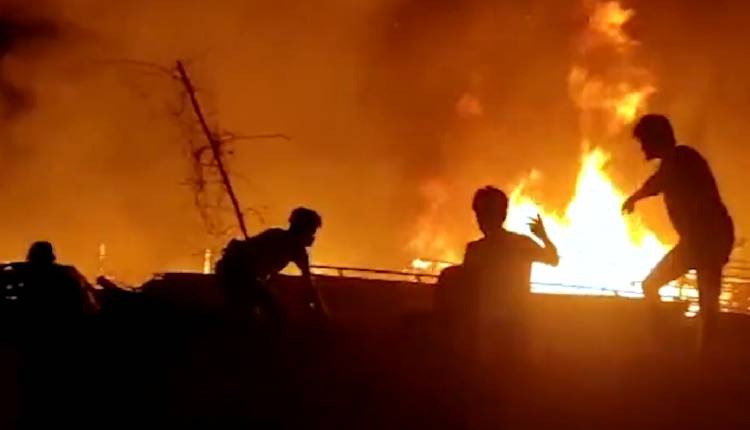
Dhaka: Bangladesh’s fire safety management in Rohingya refugee camps exposes a central paradox as humanitarian actors focus on emergency responses while the underlying causes of fire remain unaddressed. Plans for 50,000 semi-permanent, fire-resistant shelters, unveiled with fanfare, have gone unfunded after the early 2025 international aid cuts, a report has cited.
“What stands out in the humanitarian record is not just this catastrophe but the sheer recurrence: between May 2018 and December 2025, 2,425 documented fires have struck the world’s largest refugee settlement in southeast Bangladesh, affecting over 100,000 individuals and destroying more than 20,000 shelters. This is not the story of accidents. Rather, it chronicles how a refugee crisis has metastasised into something more insidious — an infrastructure of permanent crisis,” a report in ‘Global Voices’ detailed
According to the report, Cox Bazar’s refugee camp fire in January this year is not merely a risk to be managed, but an inevitability embedded into the fabric of the settlement.
“Every shelter is made of bamboo, tarpaulin, and plastic rope, with no fire-resistant materials. The population density exceeds 95,000 people per square kilometre in some blocks of the camp, and most families cook with open flames inches from their neighbours in structures that become tinder-dry each winter,” it added.
Lance Bonneau, the Chief of Mission for the International Organisation for Migration (IOM) in Bangladesh, articulated the risk with careful bureaucratic precision.
“When fires strike overcrowded camp settings, the impact extends far beyond damaged infrastructure. Families lose shelter, essential belongings, and access to basic services,” Global Voices quoted Bonneau as saying.
The report stressed that what goes unmentioned is that these impacts are not “unfortunate externalities but predictable outcomes of political decisions — to warehouse nearly one million people on inadequate land with far too few resources”.
Highlighting the organisation’s response following a January 2026 fire that displaced 2,185 people, Kaiser Rejve, CARE Bangladesh’s Head of Programmes, was quoted as saying by Global Voices: “Beyond immediate response, we are committed to strengthening prevention efforts. We will incorporate dedicated fire safety sessions into shelter upgrade and maintenance modules to raise awareness and promote safer practices.”
The report stated that the Rohingya refugees have resided in these settlements for over eight years with the Bangladesh government not intending them to be permanent, making any significant, long-term investment politically difficult.
(IANS)