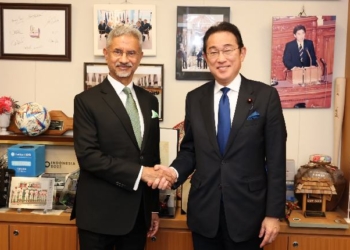






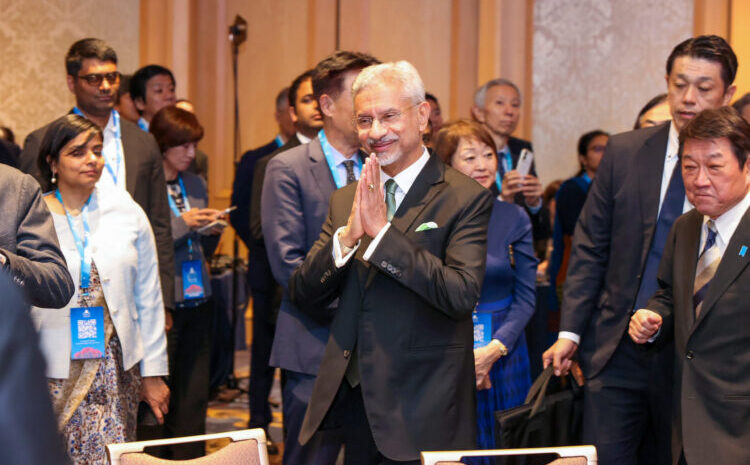
Tokyo: India and Japan must secure their own national interests, while encouraging the freedom of choice and promoting growth and stability in the Indo-Pacific, External Affairs Minister (EAM) S Jaishankar said in Tokyo on Wednesday at an event held on the sidelines of fourth India-Japan 2+2 Dialogue.
Speaking at the inauguration of Raisina Tokyo 2026, along with Japanese Foreign Minister Toshimitsu Motegi, EAM Jaishankar said that, as both countries contemplate a rapidly changing global landscape and strategise on how to deepen their relationship, the current state of the world has five defining features.
“One, the shocks to the international system: Its steady evolution through globalization over multiple decades has now been subjected one after another to the Covid pandemic, two major conflicts, trade disruptions and economic volatility. Two, weaponisation and choke points as enduring realities: Whether it is resources or energy, market access or technology, or indeed even finance, every aspect of global economic activity has been more and more openly weaponized by relevant players. Chokepoints and gateways, whether physical or virtual, have similarly become subject to strategic agendas. The era of rules, norms and assumptions is unfortunately rapidly eroding,” the EAM elaborated.
“Third, greater risk-taking: We are noting behavioural traits as well that shape the direction of events. A mindset of extreme competition along with a temptation to translate leads into outcomes is permeating various domains. Fourth, de-risking and diversification are the natural responses to these, especially of the major economies. Our choices are shaped now less by cost and efficiency, and perhaps more dependent on reliability and multiplicity. New supply chains and new economic arrangements are starting to come into being. The dangers of over-concentration are increasingly being felt, with all of us either seeking alternatives or seeking some form of mitigation,” he added.
Trusted partnerships as solutions, said EAM Jaishankar, was the fifth and final solution in the current situation.
“In such uncertain times, nations, as indeed enterprises put a much greater value on trusted partners and shorter supply chains. We are getting increasingly clear-eyed about the gaming of rules and ensuring that these are not utilized to the disadvantage of those who abide by it,” he said.
These five factors are very strongly imprinted on the Indo-Pacific landscape, the External Affairs Minister detailed. He mentioned that, as two leading nations of the region committed to maintaining a free and open Indo-Pacific, India and Japan have to secure their own national interests.
This, he said, could be best done by helping partners to build, strengthen and deepen the basis for reliable and trusted cooperation – something that the India-Japan agenda is exactly all about.
“The global context now provides the most powerful logic to strengthen our respective national capacities and to expand and deepen cooperation in key domains. For each of us, the other is a complementary partner. We have never had a clash of interests and indeed, only congenial relations throughout history. Public perceptions of each other’s society have been consistently positive,” said EAM Jaishankar.
The minister then listed factors that can provide a new momentum to India-Japan cooperation.
“One, of course, is the larger strategic context that I have just spoken about. The second is the political leadership which guides policies and encourages initiatives. In Prime Ministers Modi and Takaichi, that is certainly the case. And three, a contemporary and informed understanding of the opportunities and potential that our ties can offer. It is only then that we can seriously address the issue of promoting economic security, which is probably the overriding priority today for both countries,” he stated.
According to EAM Jaishankar, in engaging India, Japan should appreciate the transformation that India has undergone since 2014 and update its picture; Assess that India’s infrastructure progress and domestic market make it an attractive location for manufacturing and production by Japanese companies; Note India’s improvement in human resource development with results visible in education, skilling, innovation and startups, digital, space, drones, health and defence; Explore the scope for closer collaboration in advanced manufacturing, semiconductors, critical minerals, ICT, clean energy and pharmaceuticals; Develop policies and frameworks to work together in the fields of security and defence; And, support all this through stronger people-to-people linkages and societal activities.
The EAM emphasised that by expanding India-Japan ties, both sides will not only serve to stabilise and secure the Indo-Pacific but also add an important pillar to an increasingly multi-polar Asia and the world. He also asserted that much has changed in India-Japan relationship over the last three decades.
“Our economic interactions have grown and our political understanding, I think, is very, very visible. Today, we are members of the Quad. In fact, I’m just coming out of a leaders’ level meeting yesterday evening in Manila. We are partners in the G4 initiative for reforming the United Nations and we participate in the East Asia Summit platforms. By expanding India-Japan ties, we will not only serve to stabilise and secure the Indo-Pacific but add an important pillar to an increasingly multi-polar Asia and a multipolar world.
(IANS)