






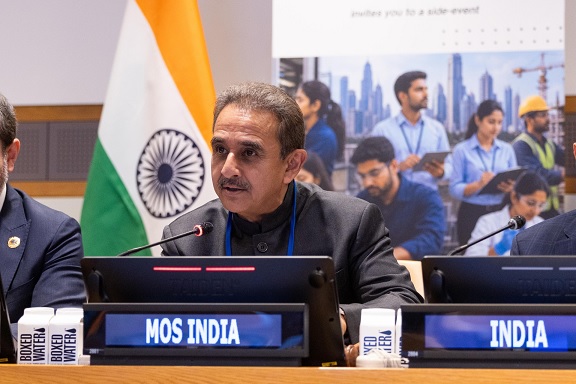
United Nations: India’s holistic approach to emigration is backed by digital innovation to cover all aspects of employment abroad, from hiring, preparation for departure, proper employment and return, according to Kirti Vardhan Singh, the Minister of State for External Affairs.
India’s eMigrate platform shows how “digital technologies are no longer just enablers, they are reshaping governance itself”, he said on Thursday at an event organised by India’s mission.
Held on the sidelines of the Second International Migration Review Forum, the event on “Leveraging Digital Innovation in Migration Governance” showcased India’s eMigrate system.
India’s holistic approach, he said, “recognises that migration is not merely a movement of people, but a continuum that spans pre-departure preparation, safe transit, dignified employment, and eventual return and reintegration”.
Singh said that eMigrate starts with vetting employers and recruiters, bringing transparency to the process of hiring by allowing prospective employees to verify them and avoid fraud.
“Currently, we have around 2,98,000 registered foreign employers and 2,457 active recruiting agents registered on the eMigrate portal”, he said. They can also recruit through the portal.
The platform serves workers by also integrating with platforms for skilling, employment, documentation, service delivery, multilingual interfaces, as well as online grievance redressal and payment transfer at no cost.
India’s Permanent Representative P. Harish said that India was making available to everyone the digital tools it has developed, like eMigrate, because of the nation’s commitment to South-South cooperation.
“We have not patented these digital public platforms. We have made it available for free, put it on the net in an open source format, made available to our friends and partners so that they can adapt it according to their needs and requirements,” he said.
“This is very much a part not only of our bilateral but also of our UN-mediated South-South cooperation frameworks that we have in assisting our friends and partners in the Global South”, he added.
Harish said that the distinction between refugees and migrants must be kept.
Ecuador’s Vice Minister of Human Mobility, Saul Pacurucu, said that his country has put 100 per cent of its consular services online and would learn from India’s experience in coordinating interoperability of digital platforms across the labour migration cycle.
International Organisation for Migration’s Senior Director Kim Eling said, “India is demonstrating how technology can be used, not simply to modernise systems, but to better protect people”.
He said the scale of eMigrate operations is “amazing”.
Saudi Arabia’s Permanent Representative Abdulaziz Alwasil said, “As a major destination country hosting a large and diverse expatriate population, with over 10 million foreign workers contributing to its labour market, the Kingdom recognises both the opportunities and the responsibilities associated with labour mobility”.
“Saudi Arabia has undertaken a wide range of reforms under its ongoing national transformation efforts to mobilise its labour market and strengthen migration governance frameworks,” he said.
Its Qiwa platform is a central “interface for labour-related services, including contract authentication, job mobility, visa issuance, proficient changes and compliance monitoring,” he said.
It links workers, employers and regulators through a unified digital ecosystem, he said.
(IANS)