





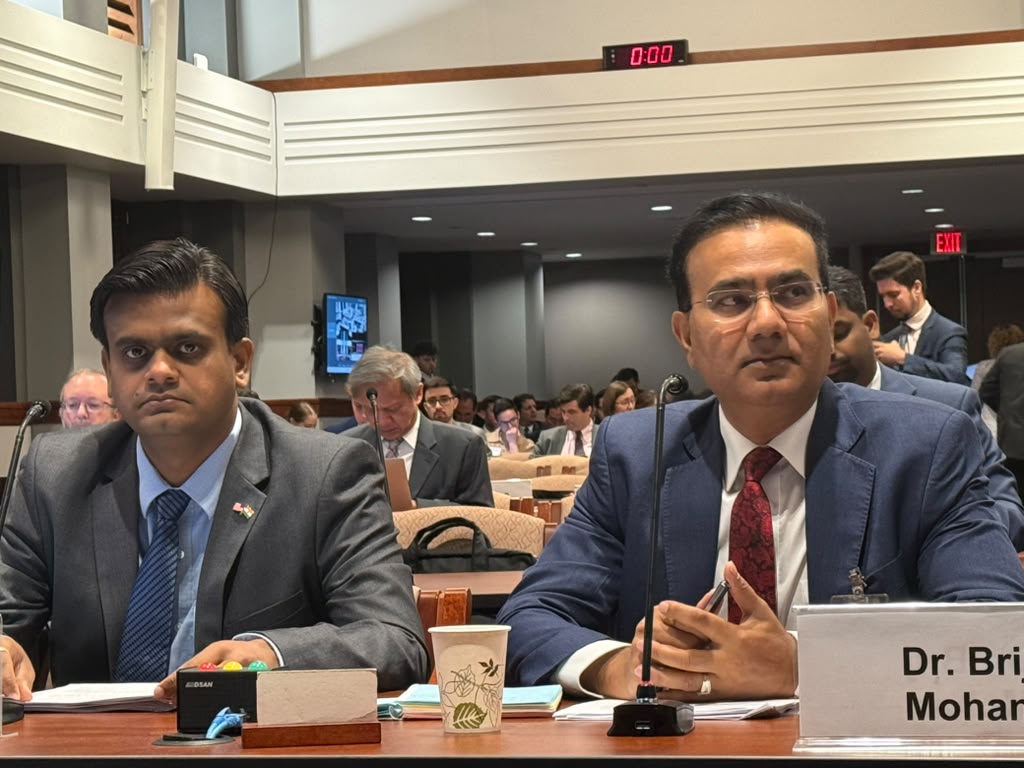
Washington: India on Wednesday strongly opposed the proposed 12.5 per cent additional US tariff on its exports during a US Trade Representative (USTR) Section 301 hearing, arguing that the investigation lacks a legal and factual basis and warning that the proposed action would disrupt supply chains without advancing efforts to eliminate forced labour.
Appearing before the USTR hearing panel, Dr Brij Mohan of the Ministry of Commerce and Industry said India objected to the proposed country-wide tariff, contending that the investigation had failed to satisfy the legal standards required under Section 301 and had not demonstrated that India’s policies burden US commerce.
He argued that “the USTR has not provided clear assessment and justification for recommending a country-wide tariff rate of 12.5 per cent against almost all imports from India”, adding that the methodology relied on “broad trade patterns” rather than sector-specific or product-specific evidence linking Indian exports to forced labour.
Dr Mohan also rejected the premise that the absence of an explicit import ban on goods produced with forced labour amounted to permitting such practices.
“The absence of an explicit forced labour import prohibition does not constitute acquiescing to or permitting forced labour in any form,” he told the hearing, adding that eliminating forced labour required multiple policy interventions tailored to country-specific circumstances rather than broad import restrictions.
He further maintained that the USTR had failed to establish any causal link between India’s regulatory framework and harm to US commerce.
“In fact, USTR data in Appendix A, such as in relation to tobacco, rice, and cotton, contradicts the demand on which it has made an adverse determination against India,” he said, arguing that the data instead showed rising US exports and negligible or declining third-country competition in India.
Following India’s principal submission, Shreyans Gupta, First Secretary (Commerce) at the Embassy of India, appeared on behalf of the Agricultural and Processed Food Products Export Development Authority (APEDA).
Gupta challenged the USTR’s findings on rice imports, saying the conclusions were based on incorrect assumptions.
He said India was the world’s largest producer and exporter of rice and that imported rice represented only a tiny fraction of domestic production, serving niche consumer demand rather than export processing. According to the submission, around 45 per cent of India’s rice imports originate from Thailand, consisting mainly of speciality jasmine varieties that are neither re-exported nor comparable to US-grown rice.
Gupta said India’s exports to the United States consist predominantly of geographically indicated basmati rice grown in designated regions of the Indo-Gangetic plains, while non-basmati exports also originate from domestic production.
He further argued that India’s imports account for less than three per cent of the value of rice exported to the US and that regulatory safeguards prevent imported rice from being exported as Indian produce.
“Export of rice from India to the US is allowed only from the rice mills registered with the Ministry of Agriculture and Farmers Welfare,” he said, adding that exporters must also comply with stringent labour standards imposed by major U.S. private sector buyers, including supermarket chains.
Gupta urged the USTR to rescind the investigation against India or, alternatively, exempt Indian rice from any proposed measures, arguing that the findings did not establish that India’s policies met the statutory threshold of unreasonableness or restricted US commerce.
Earlier during the hearing, Indian industry bodies also urged the USTR to reconsider the proposed tariff.
Poornima Shenoy of the Federation of Indian Chambers of Commerce and Industry (FICCI) said Indian industry fully supported eliminating forced labour from global supply chains but argued that an economy-wide tariff would penalise compliant sectors and increase costs for U.S. businesses and consumers without addressing the underlying issue.
Shuchita Sonalika of the Confederation of Indian Industry (CII) said India had a comprehensive legal framework prohibiting forced labour and that Indian exporters already operated under rigorous compliance systems required by global customers. She urged the USTR to pursue “compliance-based cooperation, not punitive tariffs”, warning that additional duties would disrupt well-established US-India supply chains.
The USTR launched the Section 301 investigation to examine whether several trading partners have failed to prohibit or effectively enforce restrictions on imports produced with forced labour. The public hearings in Washington bring together government officials, industry groups, labour organisations and businesses from multiple countries to present evidence before the USTR makes its final determination.
(IANS)