





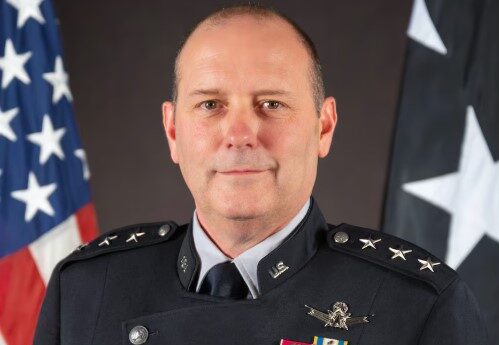
Washington: President Donald Trump’s nominee to lead the US Space Force warned lawmakers that China is developing space warfare capabilities at a “breathtakingly fast” pace, arguing that the United States must move quickly to strengthen its military advantage in orbit as Beijing builds systems capable of threatening American satellites and forces.
Lieutenant General Douglas Schiess made the remarks during his confirmation hearing before the Senate Armed Services Committee, where he pledged to build on the work of the Space Force’s first two chiefs and prepare the military’s newest service for an increasingly contested space environment.
“China’s threat is real,” Schiess told senators. “What they are doing with what I’ll call counter space and space superiority capabilities is breathtakingly fast.” He said Beijing had watched how the United States uses space to support military operations and was rapidly developing capabilities to counter those advantages.
He said China had conducted anti-satellite tests, developed capabilities that put US satellites at risk and was expanding electronic warfare systems capable of jamming American space assets.
“They are using their intelligence, surveillance and reconnaissance efforts to target our forces much farther than they ever have,” Schiess said. “They’ve built a kill chain to be able to see our carrier strike groups, our bombers at much farther pace, speed and distances.” He added that the Space Force must develop capabilities “to deny, degrade that kill web to be able to protect the joint force.”
Committee Chairman Senator Roger Wicker said the United States could no longer view space as a permissive environment, warning that both China and Russia were investing heavily in weapons designed to disrupt satellites, communications and navigation systems that underpin US military operations. He said the next chief of space operations would have to ensure the Space Force grew at a pace matching the evolving threat.
Ranking Member Senator Jack Reed said recent conflict involving Iran had demonstrated that “space is no longer a support domain it is a warfighting domain”, noting that Space Force assets had been deployed early in the conflict and had themselves become targets. He asked Schiess how he planned to prepare the service for future conflicts and strengthen cooperation with the Air Force.
Responding to a question, Schiess agreed that closer integration with the Air Force and other military branches would be essential, particularly in electronic warfare.
He also identified artificial intelligence as a critical tool for improving space domain awareness, while stressing that “we need to make sure that we have still have a guardian in the loop.”
The nominee defended the administration’s proposed Space Force budget of $71.1 billion, telling lawmakers the funding reflected the growing challenge posed by China and Russia. He said most of the increase would go towards weapon systems, facilities and training rather than personnel.
“I believe that the $71.1 billion that the President has asked for is exactly what we need,” Schiess said, adding that future conflicts involving major powers could begin in space or see the space domain become decisive at the outset.
Responding to questions about the impact of hostile action against US satellites, Schiess said any disruption to space systems would affect not only military operations but also everyday civilian life.
“It puts all of those at risk,” he said, referring to GPS, satellite communications and missile warning systems. He added that space capabilities also supported financial transactions and other services that Americans relied on daily.
The US Space Force was established in December 2019 as the first new branch of the US armed forces since the Air Force was created in 1947. It is responsible for organising, training and equipping forces to protect American interests in space and to provide space-based capabilities to the joint force.
(IANS)