





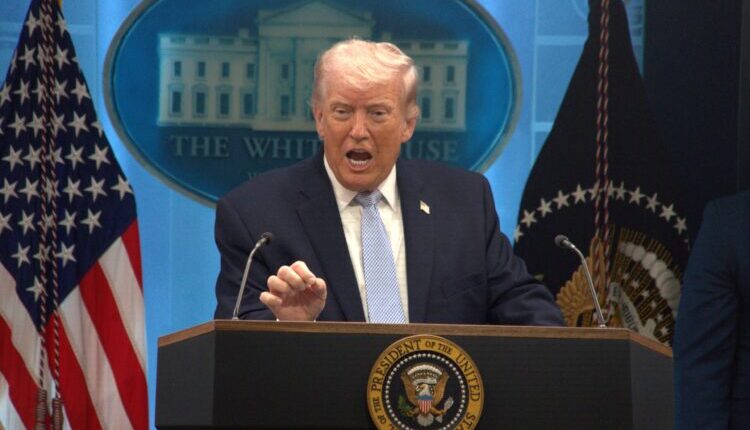
Washington: The Trump administration on Monday announced that the United States and Iran have signed a memorandum of understanding (MOU) establishing a framework for future negotiations, reopening the Strait of Hormuz and setting the stage for talks aimed at ensuring Tehran never acquires a nuclear weapon.
Senior administration officials told reporters that the agreement links sanctions relief and broader economic integration for Iran to verifiable steps on its nuclear programme, regional activities and support for militant groups. The officials described the understanding as the most significant opening in US-Iran relations in decades and said a formal signing ceremony is planned later this week.
“We have now signed a memorandum of understanding with Iran,” a senior US official said. “The more that the Iranians are willing to work with us on their nuclear program, on verifying that they’re not building a nuclear weapon, on not funding radicalism and terrorism in the region, the more that they’re going to be welcomed into the world economy through a combination of sanctions relief and other economic measures.”
The official said the agreement provides for reopening the Strait of Hormuz and lifting the naval blockade that has disrupted maritime traffic and energy markets in recent weeks.
” You will see a significant increase in traffic in the Strait of Hormuz, actually starting already, and that will ramp up slowly over time,” the official said, adding that while shipping may not immediately return to normal levels, traffic would increase substantially in the coming days and weeks.
The administration said the negotiations were made possible by a combination of military, diplomatic and economic pressure that weakened Iran’s position and brought its leadership to the negotiating table.
Another senior US official described the effort as an attempt to resolve a conflict that has shaped relations between Washington and Tehran for nearly half a century.
“This has really been a 47-year war,” the official said, arguing that Iran’s support for militant groups and pursuit of nuclear capabilities had fuelled instability across the region.
Officials said the forthcoming negotiations will focus heavily on verification mechanisms and dismantling any remaining pathways to nuclear weapons development. US officials also indicated that the agreement could eventually include sanctions relief, access to frozen Iranian funds and international investment, but only if Tehran meets specific benchmarks.
“We don’t pay for play. ….We’re prepared to give them a lot, but we expect performance,” said the official, adding that any release of frozen funds or economic incentives would be tied to measurable and verifiable actions by Iran.
The administration said it would release the MOU publicly and insisted that there would be no undisclosed arrangements.
“The MOU will be released publicly,” a senior official said. “One of our principles here is, we want to have full transparency on this, and there’ll be no side deals.”
Despite the diplomatic breakthrough, officials stressed that US military forces would remain in place during the next phase of negotiations.
“The plan is to keep the current force posture during the succeeding negotiation force,” a senior official said, adding that reductions in US deployments would only be considered after a final agreement is reached and implemented.
The administration portrayed the current talks as taking place from a position of strength. One senior official said Iran’s economy and military capabilities had been significantly weakened and claimed that “their nuclear program has been mostly destroyed.” The official argued that Tehran now understood both the capability and willingness of the United States to act if Iran attempted to pursue a nuclear weapon.
In response to a question, the official pointed to ongoing diplomatic efforts involving Israel and Lebanon and expressed hope that the agreement could eventually contribute to wider regional stability.
“I don’t think you can kill your way out of these problems,” a senior official said. “You need a diplomatic solution that allows us to get everyone to put down their weapons and hopefully focus on economics and rebuilding their countries and getting along with each other for joint prosperity and opportunity.”
(IANS)