





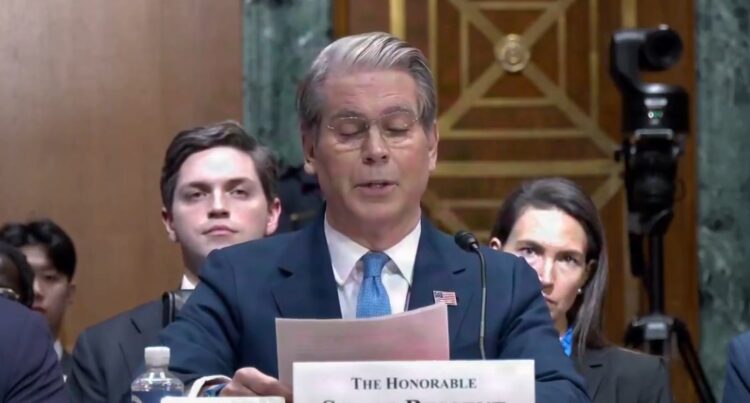
Washington: US Treasury Secretary Scott Bessent and senior Republican lawmakers on Thursday highlighted what they described as growing success in reducing US economic dependence on China, citing a shrinking trade deficit, expanding domestic manufacturing and new efforts to protect American industries from Chinese competition.
During a House Ways and Means Committee hearing on the administration’s economic policies, Republicans argued that US President Donald Trump’s trade and tax agenda was beginning to reshape America’s economic relationship with China.
Committee Chairman Jason Smith said the United States was becoming less reliant on China after years of failed attempts by successive administrations.
“America is becoming less dependent on China, a goal long promised by Washington politicians with no actual progress until President Trump,” Smith said.
He pointed to a sharp decline in the bilateral trade imbalance.
“Our trade deficit with China fell 32 per cent last year to the lowest level since 2004,” Smith told the hearing.
The Missouri Republican also highlighted agreements involving US exports, saying China had agreed to purchase significant quantities of American agricultural products.
“The Chinese recently agreed to purchase at least USD 17 billion annually in US agriculture products through 2028, alongside more Boeing airplanes,” he said.
Republicans argued that a combination of tariffs, trade negotiations and tax incentives was helping drive investment back into the United States while reducing vulnerabilities associated with Chinese supply chains.
Bessent echoed those themes, emphasising the administration’s efforts to rebuild American manufacturing capacity and attract investment.
“The president is undeterred in his determination to open markets for US goods and services while rebuilding US manufacturing capacity,” he said.
According to Bessent, the administration’s policies were already producing results.
“Over the 12 months ending March 2026, the trade deficit for goods declined by USD 370 billion compared to the same timeframe ending March 2025,” he told lawmakers.
The Treasury Secretary also cited growth in manufacturing employment and business investment.
“The economy has added 313,000 net new private sector jobs and 13,000 manufacturing jobs in the past two months,” he said.
While much of the hearing focused on domestic economic issues, concerns about China surfaced repeatedly in discussions involving trade, manufacturing incentives, technology and national security.
Republican lawmakers argued that reducing dependence on Chinese supply chains had become an economic as well as a strategic imperative. They also pointed to recent administration actions targeting Chinese technology and efforts to scrutinise Chinese involvement in federally supported manufacturing projects.
(IANS)