





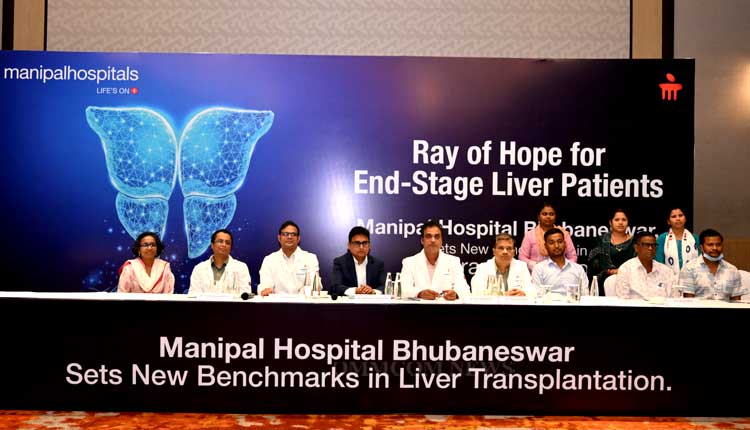
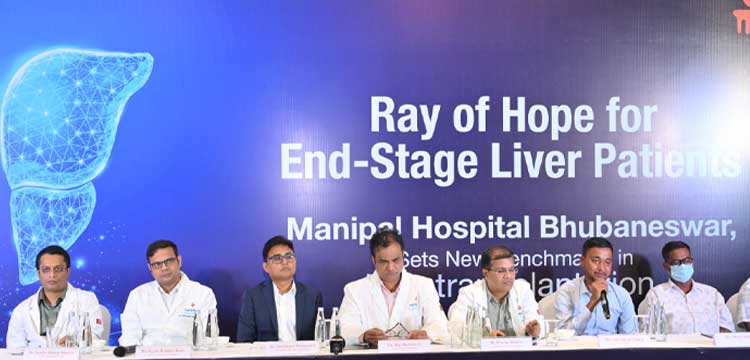
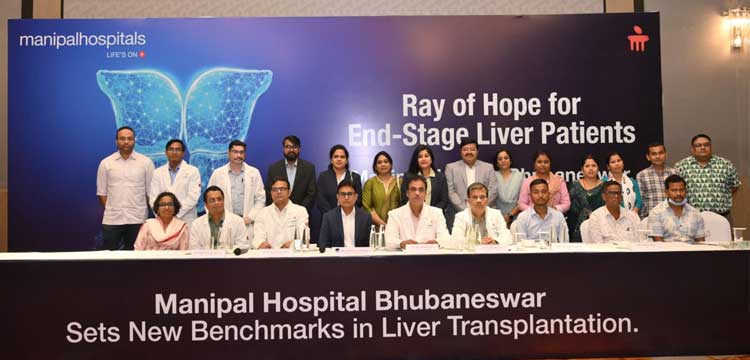
Bhubaneswar: Manipal Hospitals Bhubaneswar on Tuesday hosted a press meet reaffirming its position as a leading centre for advanced liver transplantation, highlighting both the growing burden of liver disease in Odisha and the transformative impact of timely transplant care.
Citing emerging data, doctors said nearly one in three people in Odisha may have fatty liver disease, while one in six could develop Non-Alcoholic Steatohepatitis (NASH), an inflammatory condition that can progress to cirrhosis. The prevalence of cirrhosis in the state stands at around 16.7 per cent. Across eastern India, almost half of chronic liver disease patients are diagnosed with cirrhosis, most of them at a late, decompensated stage—underscoring the urgent need for early detection, referral and intervention.
The expert panel was led by Dr. Raj Shekhar K, Consultant Liver Transplant Surgeon, and included Dr. Pratap Behera, Senior Consultant Medical Gastroenterology; Dr. Gyanranjan Rout, Consultant Medical Gastroenterology; Dr. Sambit Kumar Bhuyan, Consultant Medical Gastroenterology; and Dr. Saktimaya Mohapatra, Cluster Director (South East), Manipal Hospitals. They described liver transplantation as a major milestone reflecting the hospital’s advanced surgical expertise and multidisciplinary excellence.
Sharing his experience, Sudhir Bhutia from Angul, an employee of NALCO, said persistent stomach pain led him to seek consultation at Manipal Hospitals Bhubaneswar. Following detailed evaluation, doctors advised a liver transplant. The surgery was performed on Rakshabandhan, with his sister donating a portion of her liver. “She gave me a new lease on life,” he said, urging people not to ignore symptoms and to seek timely medical attention.
Another recipient, Muna Sahoo from Angul, spoke about the emotional strain of living with liver disease. After missing regular check-ups for nearly nine months, his jaundice worsened and his health deteriorated. Tests elsewhere revealed a missing vessel in his liver, and treatment over several months failed to bring improvement. At Manipal Hospitals Bhubaneswar, he was advised a transplant. His wife became the donor, and following the surgery in November 2025, he said he feels relieved and advocates early treatment.
From Kendrapara, Suryakant Samal described the transplant as a turning point in his life. In 2024, he began experiencing swelling, abdominal discomfort and visible physical changes that alarmed his family. After consulting Dr. Pratap Behera, he was advised a liver transplant. His wife donated part of her liver. He also acknowledged the consistent support of Dr. Jyotirmaya Jena, who remained accessible throughout the treatment process. Today, both donor and recipient are recovering well.
Dr. Raj Shekhar K stated that liver transplantation remains the best treatment option for patients with end-stage liver disease when medicines are no longer effective. “Today, it is a highly successful surgery with success rates above 95 per cent. Early referral of patients with chronic liver disease to a transplant team significantly improves outcomes,” he said.
Emphasising collaborative care, Dr. Pratap Behera noted that liver transplantation is not merely a surgical procedure but a comprehensive journey shared by patients, families and medical teams. He said the hospital aims to make liver transplantation cost-effective while ensuring zero mortality outcomes through close coordination among hepatologists, transplant surgeons, anaesthetists, intensivists and nursing teams, supported by round-the-clock monitoring and specialised critical care.
Dr. Gyanranjan Rout added that liver transplantation is an effective and curative option for patients with decompensated cirrhosis, which was previously inaccessible to many due to limited expertise and infrastructure. Advances in surgical capability have now made it a feasible treatment pathway for end-stage liver disease.
Dr. Saktimaya Mohapatra highlighted the hospital’s broader vision of combining advanced treatment with reassurance and compassion. “Our goal is to ensure that patients and families find not just medical excellence, but also the confidence that they are not alone in their journey,” he said.
The press meet concluded with transplant recipients expressing gratitude to the medical teams who supported them through some of the most challenging phases of their lives. With more than 600 kidney transplants successfully performed—the highest in the region—Manipal Hospitals Bhubaneswar has further strengthened its leadership in organ transplantation. Building on this foundation, the hospital is now preparing to expand its comprehensive transplant programme with the upcoming launch of heart transplantation services, reaffirming its commitment to precision-driven, life-saving care.