





Rourkela: In a significant advancement in intelligent transportation systems, researchers from the Department of Electronics and Communication Engineering at National Institute of Technology Rourkela have developed a smart roadside framework capable of detecting vehicles approaching blind corners and alerting drivers in real time before they come into view.
Designed to enhance safety at sharp turns and visually obstructed intersections, the system integrates Internet of Things (IoT) technology with edge computing to create an intelligent roadside assistance mechanism. By deploying surveillance cameras at strategic points near blind curves, the framework uses a computer vision algorithm to analyse live video streams, detect moving vehicles, and estimate their speed and distance from the danger zone.
Unlike conventional systems that rely heavily on cloud-based data processing, the NIT Rourkela model performs computations on edge devices installed close to the cameras. This localised processing significantly reduces communication delays and ensures that warnings are generated instantly. Drivers approaching the intersection receive timely audio-visual alerts, enabling them to take precautionary action.
The research findings have been published in the reputed International Journal of Computational Vision and Robotics. The paper is co-authored by BTech graduate K.L. Sanjeev Tudu, Prof. Santos Kumar Das, Prof. Umesh Chandra Pati, Prof. Poonam Singh, and research graduates Dr. Goutam Kumar Sahoo and Dr. Rashmiranjan Nayak.
A key feature of the proposed system is its graphical user interface, which enables traffic management centres to remotely monitor sharp corners and oversee real-time vehicle movement. During field testing, the “IoT-edge paradigm-enabled vision-based driving assistance” system successfully detected vehicles in blind zones and accurately calculated their speed and distance, even when deployed on devices with limited computational capacity. The system triggered immediate alerts whenever a vehicle entered the predefined risk area.
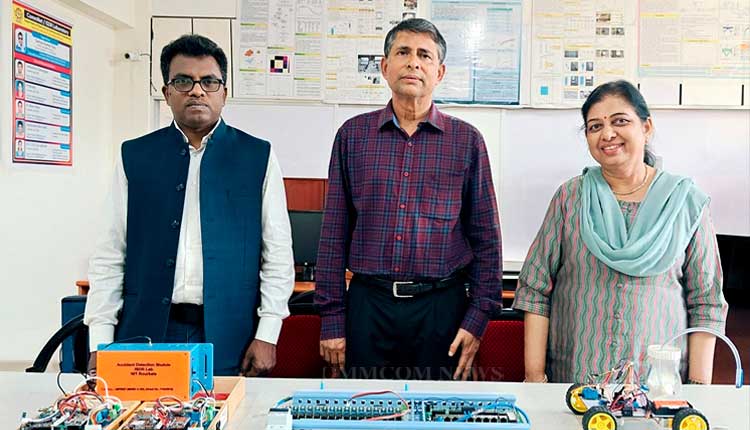
Prof. K. Umamaheshwar Rao, Director of NIT Rourkela, lauded the growing research momentum at the institute, noting that undergraduate students are increasingly contributing to high-impact international publications. He congratulated the faculty and students for their dedication to meaningful technological innovation.
Highlighting the real-world applicability of the project, Prof. Santos Kumar Das stated that the framework offers a cost-effective and scalable solution, particularly suitable for rural and hilly terrains where road geometry and limited infrastructure pose heightened accident risks. Since the intelligence is embedded within roadside infrastructure, the system eliminates the need for complex vehicle-level modifications.
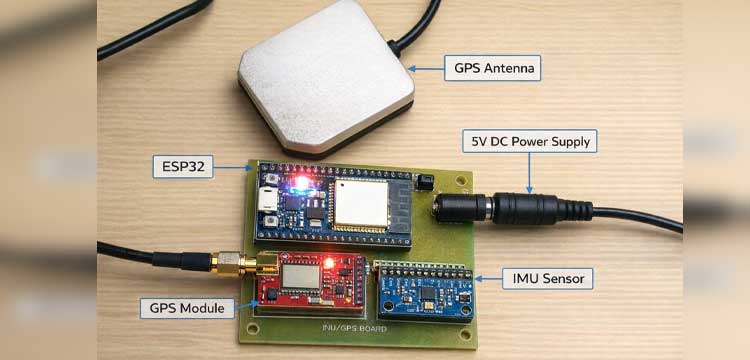
Building on this research, the team has also secured a patent titled “A Low-Cost IMU/GPS Sensor-Based Real-Time System with ESP32 for Automatic Vehicle Accident Detection and Alerting” (Patent No. 580396, Application No. 202331060341). Engineered at an estimated one-time cost of ₹6,000, the patented device integrates an Inertial Measurement Unit (IMU) and GPS technology to detect vehicular accidents and transmit emergency alerts.
The sensor-based system is designed to track vehicle location and assess impact conditions, automatically notifying first-response teams such as police, fire rescue units, ambulance services, and nearby hospitals. Complementing the hardware innovation, the researchers have developed a smartphone application named “Track,” which enables crash victims to instantly connect with emergency contacts and responders.
Looking ahead, the research team is working on a low-cost hybrid artificial intelligence framework aimed at smart city and connected mobility integration. The proposed ecosystem will combine roadside vision systems with embedded IMU-GPS accident detection units to create a distributed, intelligent safety network capable of predicting accidents and dispatching emergency alerts with greater accuracy.
With both publication and patent milestones, the NIT Rourkela initiative signals a comprehensive step toward technology-driven road safety solutions that could significantly reduce accident-related fatalities, particularly in vulnerable and infrastructure-deficient regions.