





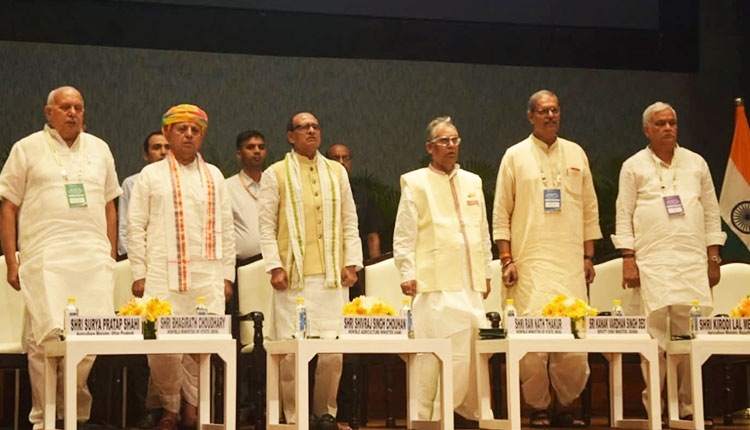
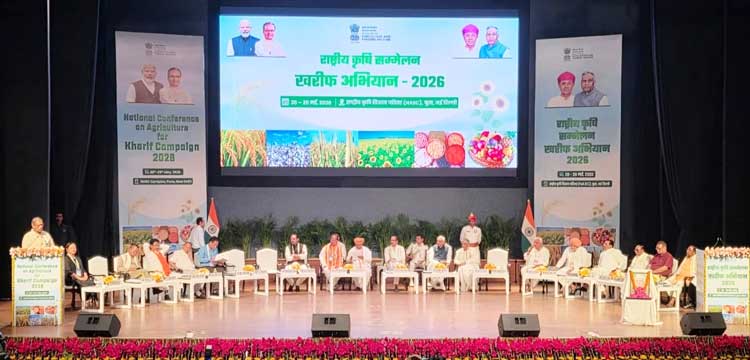
New Delhi/Bhubaneswar: Odisha has positioned itself as one of India’s fastest-growing agrarian economies, registering an estimated agricultural growth rate of 5.3 per cent for the 2025-26 fiscal year, significantly higher than the national average of 3.1 per cent, the State Government said during the National Conference on Kharif held in New Delhi.
The state highlighted that the strong growth trajectory follows a record agricultural season in 2024-25, during which Odisha produced more than 150 lakh metric tonnes of food grains and 156 lakh metric tonnes of horticulture produce.
Leading the Odisha delegation, Deputy Chief Minister Kanak Vardhan Singh Deo said the state is implementing a series of farmer-centric and climate-resilient initiatives under the Centre’s “Purvodaya” vision and Odisha’s “Vikashit Odisha @ 2036” framework.
During discussions on preparedness for the Kharif 2026 season, Odisha projected cultivation coverage of 57.40 lakh hectares. To support the target, the state announced a Rs 100 crore corpus fund for the supply of 4 lakh quintals of certified seeds and a Rs 240 crore corpus fund for the advance positioning of 11.43 lakh metric tonnes of fertilizers.

The state also highlighted the implementation of its flagship “Samrudha Krushak Yojana”, under which paddy farmers receive Rs 3,100 per quintal through additional input assistance over the Minimum Support Price (MSP).
In a major push toward agricultural modernisation, Odisha informed the conference that it is rolling out a Digital Agriculture Mission incorporating a Farmer Registry, Digital Crop Survey and AgriStack integration to streamline service delivery and improve governance.
Odisha also submitted a detailed memorandum to the Government of India seeking policy interventions and enhanced financial support for several agricultural programmes.
Under the “Mission for Atmanirvarata in Pulses”, the state requested enhancement of allocation for the pulse demonstration programme from Rs 24.74 crore covering 24,740 hectares to Rs 200 crore covering 2 lakh hectares.
The state further sought full approval of its Rs 80.50 crore annual action plan for the Digital Crop Survey, noting that only Rs 42.75 crore has been sanctioned so far.
To simplify farmer payments under the Price Support Scheme (PSS), Odisha proposed that quality inspections be conducted only once at procurement centres, enabling the State Level Supporting Agency MARKFED to release payments directly to farmers without repeated checks at warehouses.
Highlighting its focus on sustainable and heritage-linked agriculture, the state showcased the upcoming “Balabhadra Jaibika Chasa Mission”, a five-year natural farming initiative covering 16,600 hectares, as well as the “Amruta Anna” programme aimed at cultivating aromatic organic rice for Mahaprasad at the Shree Jagannath Temple.
Odisha also presented its long-term plan to develop one lakh acres of organic Koraput Coffee plantations over the next decade to improve livelihoods of tribal women farmers. The initiative has previously drawn appreciation from Prime Minister Narendra Modi.
For expansion of horticulture and oil palm cultivation, the state requested central support for high-density cotton systems, enhancement of borewell subsidy to Rs 1 lakh, inclusion of barbed wire fencing to mitigate elephant menace, and revision of cost norms for rhizomatic spices such as ginger and turmeric to Rs 1.50 lakh per hectare.
The conference was attended by Commissioner-cum-Secretary of the Department of Agriculture and Farmers’ Empowerment (DAFE) Sachin Ramchandra Jadhav, Director of Agriculture Shubham Saxena and other senior officials.