





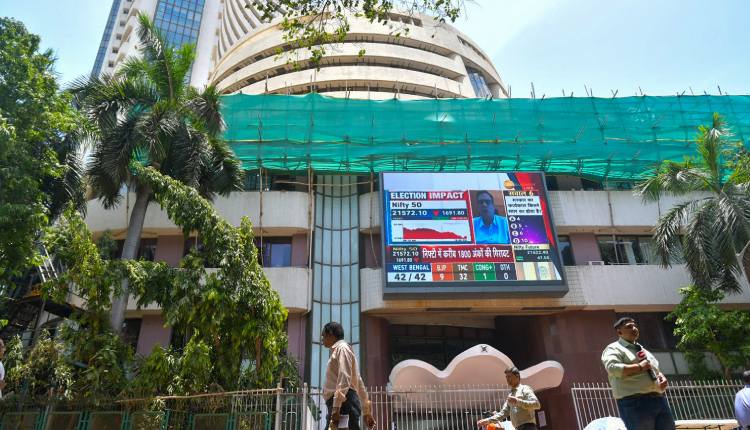
Mumbai: The macroeconomic environment remains challenging, with crude oil emerging as a key source of uncertainty for domestic markets, analysts said on Saturday, as the Indian equities endured a challenging, holiday-shortened week, with benchmark indices extending their losses.
Nifty 50 and Sensex recorded weekly declines of approximately 2.4 per cent and 2.2 per cent, respectively.
Both benchmark indices extended their losing streaks to four consecutive sessions.
The sell-off spread beyond large-cap stocks, with mid-cap and small-cap indices experiencing sharper declines as investors reduced exposure amid rising uncertainty, said market participants.
The Nifty 50 ended the week under pressure, after declining for four consecutive sessions. Persistent selling has weakened the short-term technical structure, with the index struggling to sustain its earlier recovery.
The immediate resistance zone is placed around 22,800, followed by 23,000, said analysts. For the Sensex, on the downside, 72,600–72,500 forms the immediate support zone.
The broader market took the brunt of the de-risking, as valuation concerns and the unwinding of leveraged positions triggered a disproportionately sharp correction in mid- and small-caps, while large-caps held up comparatively better.
Across sectors, IT was the lone pocket of resilience, recovering from early selling to end the week largely unchanged on improving earnings visibility and renewed investor appetite.
However, rate-sensitive sectors such as consumer durables, metals and realty saw the heaviest selling as input-cost and margin worries resurfaced, said analysts.
Brent crude oil rose to a six-month high on Friday. Brent futures gained 3.1 per cent to close at $116.72 a barrel, highest since April 29. US West Texas Intermediate added 3.8 per cent to settle at $103.27 a barrel.
Brent added 6.2 per cent for the week, while WTI advanced 2 per cent for the week.
According to analysts, sustained increases in crude prices could raise energy and transportation costs, weigh on consumption and intensify pressure on oil-sensitive sectors.
(IANS)