





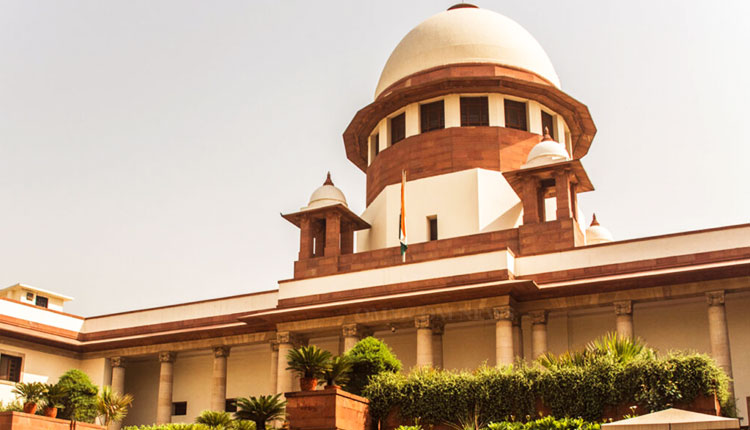
New Delhi: The Supreme Court on Monday clarified that an accused does not have an unqualified right to have an advocate continuously present throughout police interrogation, holding that Section 38 of the Bharatiya Nagarik Suraksha Sanhita (BNSS) only guarantees the right to meet a lawyer during interrogation and not the lawyer’s uninterrupted physical presence.
A bench of Justices Vikram Nath and Sandeep Mehta modified a series of conditions imposed by a trial court and partly affirmed by the Andhra Pradesh High Court while granting police custody of a suspended police inspector accused in a custodial death case, observing that some safeguards had become impractical and hampered effective investigation.
Interpreting Section 38 of the BNSS, the Justice Vikram Nath-led Bench said that the statutory provision cannot be stretched to require an advocate’s constant presence during every moment of questioning.
“A plain reading of the provision makes it clear that the right guaranteed thereunder is the right to meet an advocate of choice during interrogation. It does not, by any means, contemplate the continuous, ongoing physical presence of an advocate for the entirety of each interrogation session,” the apex court said.
It held that while the conditions allowing the accused to nominate advocates and regulating their presence at the interrogation site were “unobjectionable” and “salutary”, the direction permitting an advocate’s presence “at any given point of time during the interrogation”, if interpreted as conferring an absolute right to remain present throughout, travelled beyond the scope of Section 38 of the BNSS.
Modifying the conditions, the bench directed that the accused’s lawyer may remain present at a place from where he can see the accused during interrogation but cannot be permitted to intervene in the investigation “at any cost”.
It also held that confining the entire custodial interrogation to the Central Prison at Rajamahendravaram was neither justified nor sustainable, observing that such a restriction would seriously impair the investigation in a case involving alleged custodial death, where the victim’s body remains untraced, and recoveries are yet to be effected.
It further said that the apprehensions expressed by the investigating agency about the hurdles created by the conditions imposed by the courts below were “realistic and justified”, while observing that constitutional safeguards protecting an accused against coercion, assault or third-degree methods are inherent under Article 21 and remain binding on the investigating agency irrespective of specific judicial directions.
On videography of interrogation, the Supreme Court retained the requirement of CCTV coverage and audio-visual recording of interrogation sessions, saying such safeguards protect both the accused against coercion and the investigating agency against unfounded allegations.
However, it held that requiring uninterrupted videography of every movement of the accused during transit over long distances was “unworkable in practice” due to logistical constraints such as signal loss, battery limitations, and security considerations.
The judgment came on an appeal filed by the Andhra Pradesh government against an Andhra Pradesh High Court order which had substantially retained several conditions imposed by a Magistrate while granting police custody of an Inspector accused in a custodial death case. The state government had argued that the restrictions rendered effective custodial interrogation virtually impossible.
(IANS)