





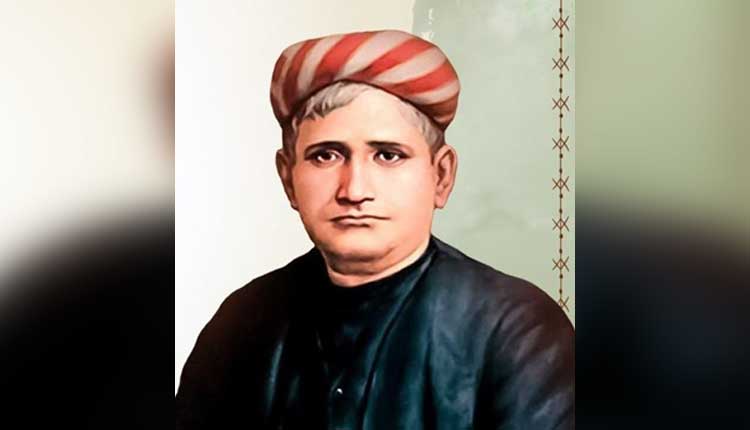
New Delhi: Prime Minister Narendra Modi on Friday paid tributes to Bankim Chandra Chattopadhyay, the celebrated novelist, poet, essayist and journalist, on his birth anniversary, saying that the towering literary figure awakened a deep spirit of patriotism and cultural pride among generations of Indians.
PM Modi took to social media ‘X’ and said, “Tributes to the great Bankim Chandra Chattopadhyay on his Jayanti. A towering literary luminary, his writings awakened a spirit of patriotism and cultural pride among generations of Indians. His rich literary work continues to illuminate minds and strengthen our collective resolve towards nation-building.”
“This is a time when we are marking the 150th anniversary of Vande Mataram. Through Vande Mataram, he gifted the freedom movement and our nation one of its most enduring inspirations,” he said.
Union Home Minister Amit Shah also offered respectful homage and said, “On the birth anniversary of the great literary figure and pioneer of cultural nationalism, Bankim Chandra Chattopadhyay, I offer my respectful homage to him.”
“Through his immortal work ‘Anandamath’, he conveyed the message of dedication to the motherland, sacrifice, and national consciousness. With the composition of ‘Vande Mataram’, he gave the Indian freedom struggle new strength, inspiration, and an ideological foundation. Today, on the occasion of the 150th anniversary of ‘Vande Mataram’, its original form continues to carry the message of national unity and collective pride across the country,” he said.
Bankim Chandra Chatterjee, born on June 26 or 27, 1838, near Naihati in Bengal, was an influential Indian author whose novels firmly established prose as a literary medium for the Bengali language and helped shape modern Indian fiction on European lines. He passed away on April 8, 1894, in Calcutta.
Born into an orthodox Brahmin family, Bankim Chandra was educated at Hooghly College, Presidency College in Calcutta, and the University of Calcutta, where he was among the earliest graduates. From 1858 until his retirement in 1891, he served as a Deputy Magistrate in the Indian Civil Service.
His early literary works appeared in Sambad Prabhakar, and in 1858, he published a collection of poems titled ‘Lalita O Manas’. He initially wrote in English, and his novel ‘Rajmohan’s Wife’ was serialised in the Indian Field in 1864. However, his first major Bengali novel, ‘Durgeshnandini’, marked a turning point in Bengali literature. Though structurally simple, it captivated readers and laid the foundation for the Bengali novel, as noted by contemporary thinkers.
He followed it with ‘Kapalkundala’ in 1866, a romantic tale set against a mystical backdrop, and ‘Mrinalini’ in 1869, which depicted historical themes from the period of early Muslim invasions in Bengal.
Bankim Chandra’s novels are often described as compelling yet structurally imperfect due to serial publication constraints. His plots sometimes relied on coincidence or supernatural elements, and his characters were frequently shaped by ideological themes. Despite these limitations, his literary influence was profound. His works inspired nationalist sentiment, and his portrayal of heroic figures stirred pride and patriotism.
His philosophy of nationalism and cultural identity found its most powerful expression in the hymn Vande Mataram, drawn from his novel ‘Anandamath’, which later became a defining slogan of India’s freedom struggle.
(IANS)