





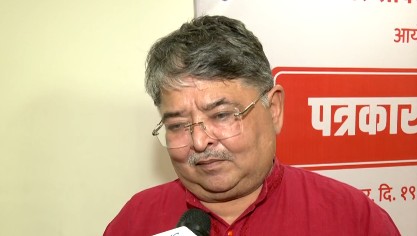
Mumbai: Ranjit Savarkar, grandson of VD Savarkar, on Thursday, hit out at Congress Parliamentary Party (CPP) Chairperson Sonia Gandhi over remarks on the Hindutva ideologue in her memoir, asking Gandhi to examine former Prime Minister late Jawaharlal Nehru’s role in the 1947 Partition.
This comes a day after the Shiv Sena tore pages of Gandhi’s memoir ‘Belonging: A Journey of Love’, over the remarks about Savarkar, appearing on pages 201 and 443 of the book.
The controversy erupted after Sonia Gandhi wrote that while Congress freedom fighters were facing assaults and imprisonment under British rule, senior RSS ideologues such as Savarkar were writing mercy petitions to the colonial authorities.
Speaking to IANS, Ranjit Savarkar asserted that the Congress leader’s claims were not correct.
“I was told that she has written that Nehru faced lathi blows while Savarkar kept pleading for mercy. He (Savarkar) did not seek mercy; this is my challenge. Nobody has been able to show any proof of it,” he said.
He noted that Savarkar was imprisoned by the British in the Andaman Islands until 1924 and then kept in Ratnagiri for another 13 years.
“Altogether, he remained under British confinement for 27 years. Yet people continue to claim that Savarkar kept seeking mercy,” he said.
However, Ranjit Savarkar cited the records of India’s Partition by Lord Mountbatten, saying, “Once those reports became public, everything came to light.”
Noting that Lord Mountbatten had invited Nehru to Shimla and showed him his initial transfer-of-power proposal, he said: “Could they not have shown the proposal to him in Delhi? Nehru was not even a minister at the time, yet the proposal was specifically shown to him.”
“Then, when the Partition proposal returned from the London Cabinet on May 10, it was given to Nehru. On May 11, Nehru reportedly rejected it completely, saying in very strong terms that he did not agree with it and was disappointed. But then he suddenly accepted it the next morning on the 12th. Sonia Gandhi should examine what happened that caused such a dramatic change of decision within a day,” he stated.
Ranjit Savarkar alleged that Nehru’s plan was, “in some ways, even more dangerous” than the original proposal as the former PM “didn’t want the blame of the Partition and that of the resulting bloodshed to fall on the British”.
“In fact, Nehru said that both the Muslim League and Congress were willing to accept responsibility, provided power was transferred immediately and authority was handed to the existing partners, namely Liaquat Ali Khan and Nehru. This was accepted, and instead of allowing the process to continue until June 1948 as originally envisioned, India’s Partition was carried out much earlier, in just 72 days, leading to immense bloodshed. Therefore, Nehru bears responsibility for it. The documents show this clearly,” he stated.
Further, he asked Congress to stop saying that Nehru suffered lathi charges without discussing the broader historical record.
“I do not know when those lathi charges happened. What I do know is that the sacrifices of revolutionaries should not be insulted,” he said.
Meanwhile, video footage from Wednesday’s demonstration by Shiv Sena leaders appeared to show Shaina NC tearing a sheet of paper that also carried an image of Balasaheb Thackeray alongside Congress leader Mani Shankar Aiyar. The clip quickly went viral, sparking widespread condemnation and street protests from opposition parties.
Reacting to the same, Ranjit Savarkar said it might have been a mistake on the part of the Shiv Sena.
“I do not think anyone in Maharashtra would deliberately disrespect Shiv Sena’s founder (Bal Thackeray). As far as I know, an apology may also have been issued…Tearing a book is generally a symbolic form of protest. Just as people sometimes burn effigies, it is a way of expressing anger or opposition. Beyond that, it does not achieve much,” he said.
The passage on Veer Savarkar in Sonia Gandhi’s book that triggered the row reads, “While Congress freedom fighters were enduring assaults and imprisonment at the hands of the British rulers, senior ideologues of the RSS like Vinayak Damodar Savarkar were writing mercy petitions to their colonial masters and their members were colluding with the British authorities as informers.”
Another passage, on page 443, says, “That ideology dismisses the delineation of the country and the rights of its citizens set down in the Constitution as ideas opposed to the ethos of Hindu civilisation, ideas they dismiss as being derived from Western countries with fundamentally alien values.
(IANS)