





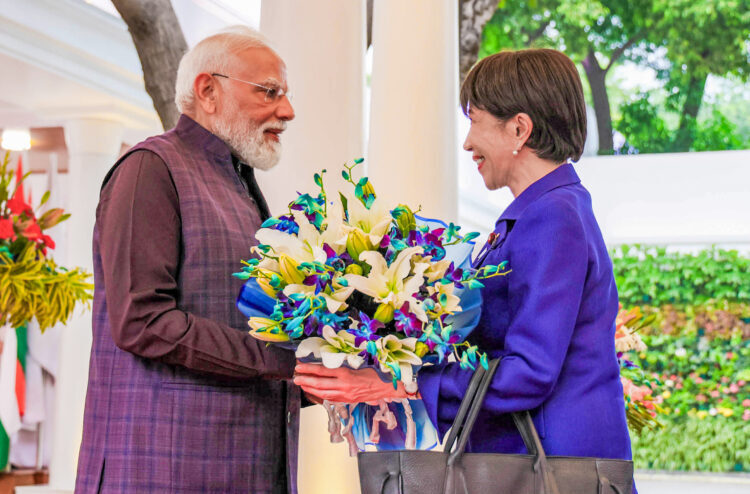
Tokyo/New Delhi: The 16th India–Japan Annual Summit held recently in New Delhi reaffirmed the strategic direction of bilateral ties rather than being defined by any single agreement. It reflected the steady transformation of the relationship beyond development assistance, infrastructure, and trade, a report has stated.
The summit also reinforced Prime Minister Narendra Modi’s central role in the partnership, with his leadership consistently translating broad goodwill into strategic continuity and sustained momentum, former Indian diplomat Sanjay Kumar Verma wrote in ‘India Narrative’.
“Diplomatic summits are often judged by the agreements they produce. But their deeper significance lies in whether they alter how two countries see each other. Prime Minister Sanae Takaichi’s recent visit to India, and the outcome of her summit with Prime Minister Narendra Modi, are likely to be remembered for doing exactly that. The Joint Statement issued after the summit does more than record fresh initiatives. It suggests that India and Japan are entering a new phase of engagement — one that may best be described as the era of “Strategic Trust,” Verma detailed.
“That is more than a neat phrase. It reflects a real shift in the logic of the relationship. New Delhi and Tokyo are no longer speaking only of cooperation in broad terms. They are beginning to rely on one another in areas that now sit at the heart of national resilience, technological strength, and economic security. Just as important, the relationship has been shaped by more than a decade of steady political attention from Prime Minister Narendra Modi, whose role has become central to the partnership’s continuity and direction,” he further stated.
Verma noted that defence and maritime security remain a key pillar of the partnership, with cooperation steadily deepening through joint exercises, dialogue, and enhanced interoperability. The summit, he said, signalled a further push towards defence industrial collaboration and co-development, marking an important milestone.
“Countries do not co-develop sensitive technologies unless they trust each other deeply and believe the partnership will endure. Maritime cooperation, regional connectivity, and a shared commitment to a free, open, and rules-based Indo-Pacific all reinforce the same strategic direction. India’s Indo-Pacific vision and Japan’s long-standing advocacy of a Free and Open Indo-Pacific now align more closely than before,” he stated.
According to Verma, the strategic implications extend beyond the bilateral relationship, with deeper India–Japan cooperation in technology, supply chains, and defence likely to attract attention in Beijing. He added that it may be viewed as part of a broader pattern of strategic coordination among major Indo-Pacific democracies, underscoring the partnership’s wider geopolitical significance.
“Taken together, these developments point to a real shift in the relationship’s philosophy. India–Japan ties are no longer organised mainly around individual projects, however significant those projects may be. They are increasingly organised around shared capabilities. Infrastructure changed India’s physical landscape. Shared capabilities are likely to shape its strategic landscape,” said the seasoned diplomat.
He noted that as geopolitical competition intensifies and technology changes accelerate, countries are reassessing how they build partnerships.
“The era of hyper-globalisation rewarded efficiency, scale, and low cost. The new era gives greater weight to resilience, technological sovereignty, and trusted collaboration. India and Japan now have a framework that allows them to navigate that transition without abandoning open markets or a broader commitment to regional stability,” Verma stressed.
(IANS)