





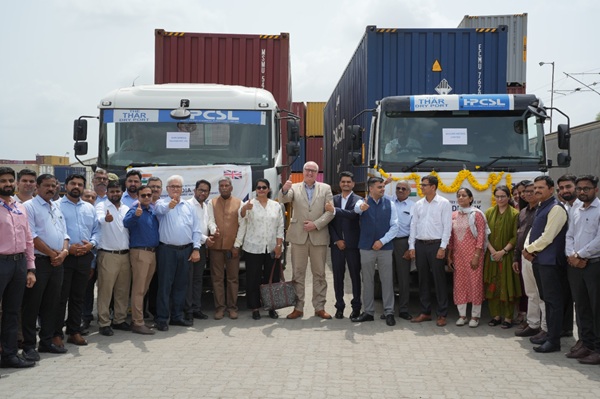
Ahmedabad: Ahmedabad marked the operational launch of exports under the India-United Kingdom Comprehensive Economic and Trade Agreement (CETA) on Wednesday as the first export consignment from the region destined for the United Kingdom was flagged off from the Inland Container Depot (ICD) at Sanand, signalling the start of preferential tariff trade under the agreement that came into force on July 15.
The consignment, valued at more than Rs 3.07 crore, comprised cargo from seven exporters in the Ahmedabad region and was organised by the Office of the Additional Director General of Foreign Trade (DGFT), Ahmedabad, in association with the Customs Department.
The flag-off ceremony was attended by the British Deputy High Commissioner in Ahmedabad, Stephen Hickling, the Additional Commissioner of Customs, Ram Vishnoi, and the Joint Director General of Foreign Trade, Rahul Singh.
Assistant DGFTs Deepshikha Singh and Divya Patel, along with representatives of the exporting companies and the Export Promotion Council, were also present.
According to the Ministry of Commerce and Industry, the consignment was worth Rs 3,07,76,171.36 and included shipments from JCB Industries Pvt. Ltd, Otsuka Pharmaceutical India Pvt. Ltd, Maruti Suzuki India Limited, Canpac Trends Pvt. Ltd, Secure Meters Ltd, Shri Ambica Polymer Pvt. Ltd and Vishakha Polyfab Pvt. Ltd.
The exports cover a range of sectors, including industrial equipment, pharmaceuticals, automobiles, polymers and textiles, reflecting the breadth of Ahmedabad’s manufacturing and export base.
Officials said Gujarat is expected to be among the major beneficiaries of the India-UK trade agreement.
The state is expected to gain from increased export opportunities in pharmaceuticals centred in Ahmedabad, chemicals from Surat and Bharuch, engineering goods from Rajkot and marine products from Veraval.
The agreement is also expected to improve access to the UK market for micro, small and medium enterprises by lowering trade barriers.
The India-UK Comprehensive Economic and Trade Agreement was signed in London on July 24 last year by Union Commerce and Industry Minister Piyush Goyal and the United Kingdom’s Secretary of State for Business and Trade, Jonathan Reynolds, in the presence of Prime Minister Narendra Modi and British Prime Minister Keir Starmer.
The agreement, together with the Double Contribution Convention (DCC) on social security, entered into force on July 15. Under CETA, 99 per cent of India’s exports to the UK, covering almost the entire value of bilateral merchandise trade, receive duty-free market access.
The agreement covers labour-intensive sectors such as textiles, leather, marine products, gems and jewellery and toys, alongside engineering goods, chemicals and automobile components.
India has, in turn, opened 89.5 per cent of its tariff lines, covering 91 per cent of UK exports, while retaining protections for sensitive sectors including dairy products, cereals, pulses and certain essential oils.
The accompanying Double Contribution Convention exempts Indian professionals on temporary assignments in the UK from making dual social security contributions for up to five years.
The provision is expected to benefit more than 75,000 professionals and over 900 Indian companies, with estimated annual savings exceeding Rs 4,000 crore.
India and the United Kingdom currently conduct bilateral trade worth about USD 56 billion, including merchandise trade of around USD 23 billion and services trade of approximately USD 33 billion.
Both governments have set a target of doubling bilateral trade by 2030 under the new trade framework.
(IANS)