






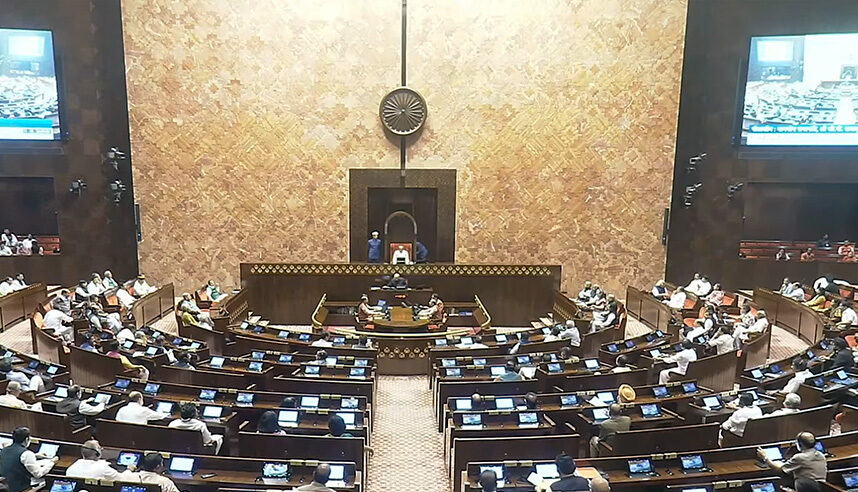
New Delhi: The Rajya Sabha, the Upper House of Parliament, on Wednesday passed the Prevention of Insults to National Honour (Amendment) Bill, 2026. The legislation makes the intentional insult of the national song ‘Vande Mataram’ or deliberate obstruction of its rendition a punishable offence.
With this amendment, ‘Vande Mataram’ now receives the same legal protection already extended to the National Flag, the Constitution and the National Anthem under the 1971 Act.
The Bill was cleared amid protests and a walkout by the Opposition.
Under the provisions of the Bill, obstructing or insulting the rendition of ‘Vande Mataram’ will attract a prison term of up to three years, a fine, or both. The legislation also emphasises the singing of all six stanzas of the national song.
This development follows a recent Home Ministry directive requiring states to play or sing the national song at official events, particularly those where the national anthem is performed.
The order specifies that “when the national song and the national anthem are sung or played, the national song will be sung or played first,” and that it must be rendered while standing at attention. The government has described the move as a step to safeguard national symbols and uphold the dignity associated with the song that played a pivotal role in India’s freedom struggle.
The Prevention of Insults to National Honour Act was enacted in 1971 to protect the dignity of India’s key national symbols — the National Flag, the Constitution and the National Anthem (‘Jana Gana Mana’). The law made intentional acts of disrespect or obstruction towards these symbols a punishable offence, reflecting the country’s resolve to uphold national honour after Independence.
The Prevention of Insults to National Honour (Amendment) Bill, 2026, expands the scope of this existing Act to bring the National Song ‘Vande Mataram’ under the same legal protection.
The amendment specifically covers three categories of acts: deliberately insulting ‘Vande Mataram’, intentionally preventing or obstructing its singing, and any other action treated as contrary to the honour of the national song. All such acts will now attract criminal liability, with the law providing for a maximum imprisonment of up to three years.
The purpose of the amendment is to place ‘Vande Mataram’ on an equal footing with the other protected national symbols.
The government has stated that the change was necessary to safeguard a song that holds deep historical significance in the freedom struggle and was accorded equal status with the National Anthem by the Constituent Assembly in 1950.
The move comes at a time when the nation is marking 150 years of the composition of ‘Vande Mataram’, further underlining the intent to reinforce respect for this important national symbol. The government has described the step as necessary to safeguard symbols associated with national honour.
According to the provisions of the new law, acts such as deliberately insulting ‘Vande Mataram’, intentionally obstructing its singing, or any action considered contrary to national honour will attract criminal liability. The Bill provides for a maximum imprisonment of three years for offences related to the insult of national symbols.
The Bill has been passed at a time when several programmes are being organised across the country to mark the 150th anniversary of ‘Vande Mataram’.
Composed by Bankim Chandra Chattopadhyay and later included in his novel “Anandamath”, the song emerged as a powerful symbol of national consciousness during the freedom struggle and was subsequently accorded the status of India’s National Song.
While the government maintains that the amendment strengthens respect for national symbols, the legislation is expected to spark further debate on the precise legal definitions of ‘insult’ and ‘obstruction’.
Questions are likely to arise over whether a clear distinction will be drawn between deliberate disruption and an individual’s decision not to participate in the singing of the national song. The passage of the Bill in the Upper House marks a significant expansion of the legal framework protecting India’s national symbols.
(IANS)