





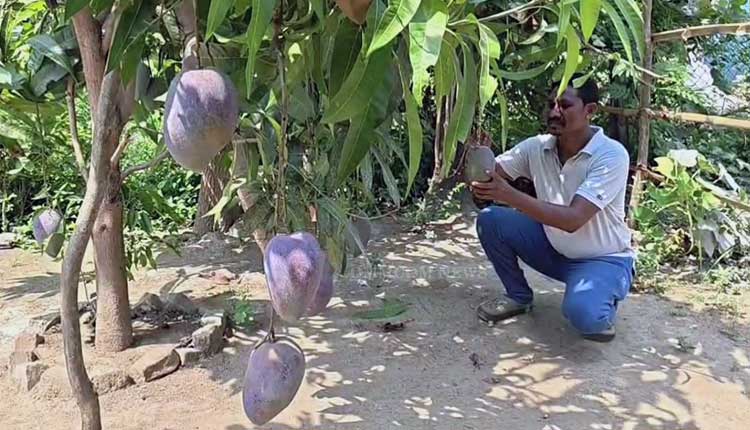
Malkangiri: In a remarkable agricultural achievement, the world’s most expensive mango variety, the Japanese Miyazaki mango, has been successfully cultivated in the remote district of Malkangiri in Odisha.
Deba Madakami, a farmer from Tamasa village, has produced Miyazaki mangoes in his garden after four years of dedicated care. This year, the tree has borne fruit that is now ripening, turning the farmer’s hard work into reality.
Each mango weighs more than one kilogram and is valued higher than gold in international markets, with prices ranging from Rs 1.5 lakh to Rs 2 lakh per kilogram abroad. Known as “Egg of the Sun” in Japanese, the Miyazaki mango is originally grown only in Japan and is famous for its exceptional sweetness, vibrant colour, and rich flavour.
Deba Madakami has taken extraordinary measures to protect his precious tree. He has erected a strong bamboo fence around it and even sleeps in the garden at night to guard against theft.
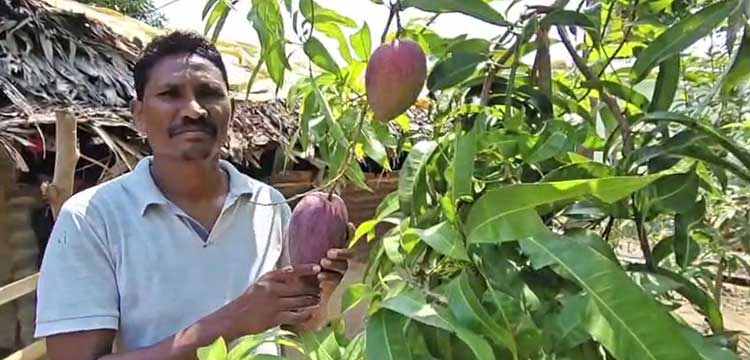
The journey began four years ago when social worker Sarv Kumar Bisoyi brought a Miyazaki mango sapling from Bhubaneswar and handed it over to Deba, as he did not have enough space in his own garden. The sapling thrived under Deba’s care, and this season it has finally yielded marketable fruits.
Curious visitors from nearby areas and even from far-off places are now flocking to Tamasa village every day just to see the rare mangoes. However, despite the excitement, Deba faces a serious challenge — finding buyers. “There are no people in the district or even in Odisha who can afford to buy these mangoes,” he said, expressing concern over where and how to sell the produce.
As the mangoes begin to ripen, Deba is worried about preservation and marketing. He hopes the state government’s Horticulture and Agriculture departments will extend support so that he can sell the fruits at a good price and expand cultivation. “We want to increase production in the coming days, but we will need help with preservation and marketing,” Deba added.
Sarv Kumar Bisoyi, who facilitated the planting, believes this success in the tribal-dominated Malkangiri plateau opens new opportunities. “If the Horticulture and Agriculture departments promote this variety and encourage farmers, many more people in this region can benefit,” he said.
This is only the second or third known location in India where Miyazaki mangoes have been successfully grown. A mango orchard of this species also exists in Jabalpur, Madhya Pradesh. With this breakthrough in Odisha, there is now hope that more farmers in Malkangiri and other parts of the state may take up this high-value exotic variety in the coming years.