





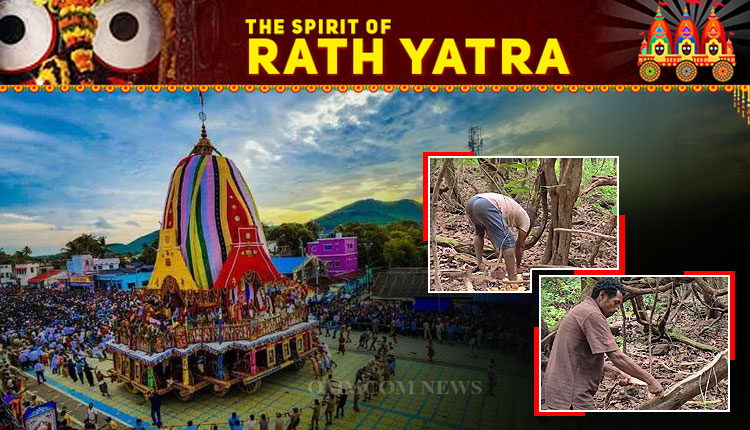
Every year during the Rath Yatra, the majestic Nandighosa chariot of Lord Jagannath in Kendujhar is pulled not by ordinary ropes but by specially prepared ropes made from Siali creepers (Siali lata) collected from the forests. While strong ropes are commonly used in Puri and other parts of the country, Kendujhar proudly follows this distinctive local tradition that blends deep devotion, mythology, Adivasi culture, and royal heritage.
For nearly four centuries, the mighty Nandighosa — recognised as the world’s tallest chariot — has been pulled every year during the Rath Yatra by sacred ropes crafted from the bark of Siali creepers. This unique tradition continues to define the annual festival at the Sri Baladevjew Temple in Kendujhar.
As the Rath Yatra festivities gain momentum, Ommcom News delves deep into the ancient art of crafting these sacred chariot ropes using Siali creepers.
Historians note that the Bhuyan community has shouldered this revered responsibility for generations. The sturdy ropes are meticulously handcrafted from the bark of Siali creepers sourced from the surrounding forests. Traditionally, as many as six Bhuyan ‘Pirhas’ — large settlements housing hundreds of community families — would collectively supply the ropes. Over time, however, due to the dwindling availability of quality creepers and other challenges, the tradition has been lovingly preserved by a single village: Danla in Suakati panchayat under Banspal block.
The Making of Sacred Ropes
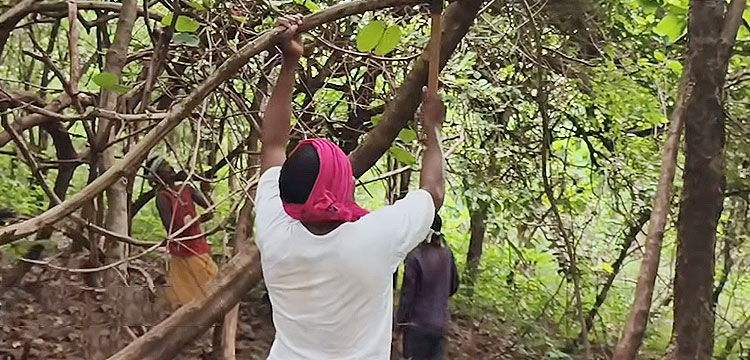
As the sacred festival approaches, the villagers of Danla come together with deep devotion to prepare the Siali ropes for the Nandighosa chariot. Beginning on Akshaya Tritiya, they trek to the Gandhamardan hills to collect the bark of Siali creepers. The finished ropes are impressive in scale — nearly 150 feet long and up to 18 inches thick. They make a total of three ropes for the Car Festival. On Snana Purnima, after seeking divine permission, the villagers begin making the ropes.
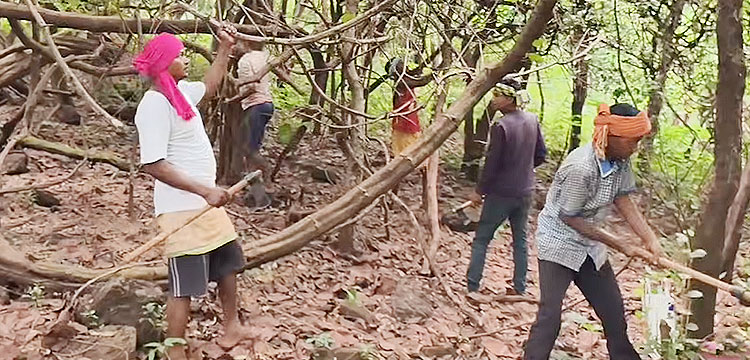
In earlier times, five ropes were prepared — three by the Bhuyan people and two by the Juang community. Today, the chariot is pulled using three such ropes.
After collecting suitable Siali creepers, the villagers dry the creepers and craft into strong ropes. Once the ropes reach the chariot site, they are accorded divine status. Through Vedic mantras and rituals, the three ropes are named Ananta, Basuki, and Mahapadma. After proper worship and puja, they are ceremonially attached to the Nandighosa chariot.
A Mythological Bond
The use of Siali creeper ropes is not merely a practical arrangement for pulling the chariot. It carries profound spiritual and historical significance.
According to legend, in the Dwapara Yuga, Lord Krishna was playing with Siali creepers in the forest when he was struck by the arrow of Jara Sabara, marking the end of his earthly leela. To eternally commemorate this event and express unwavering devotion to Mahaprabhu, the kings of Kendujhar established the tradition of pulling the Nandighosa chariot with ropes made from Lord Krishna’s beloved Siali creepers.
Every year, thousands of devotees gather and pull the chariot with these sacred Siali ropes, turning the occasion into a vibrant expression of faith. For the Adivasi communities, this is not just a custom but an integral part of their spiritual identity.Researchers describe this tradition as a unique symbol of Kendujhar’s cultural distinctiveness — a beautiful synthesis of royal heritage, indigenous Adivasi culture, and the timeless Jagannath tradition.
By Rashmi Rekha Das