





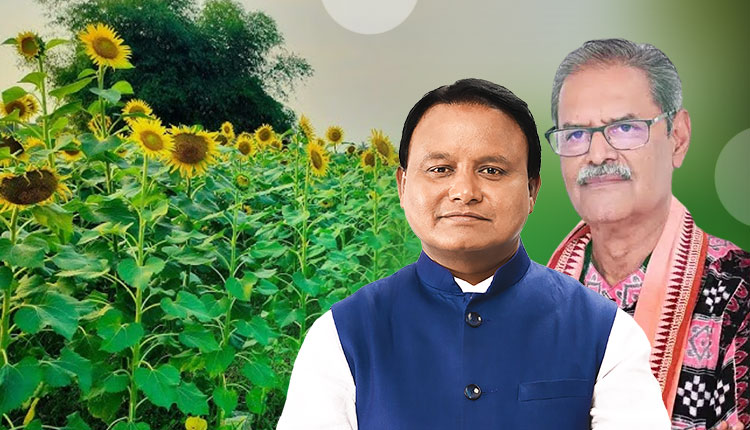
Bhubaneswar: Odisha Chief Minister Mohan Charan Majhi and Deputy Chief Minister and Agriculture and Farmers’ Empowerment Minister Kanak Vardhan Singh Deo on Wednesday welcomed the Union Cabinet’s decision to increase the Minimum Support Prices (MSP) for 14 kharif crops for the 2026–27 marketing season.
The decision was taken by the Cabinet Committee on Economic Affairs (CCEA), chaired by Prime Minister Narendra Modi, as part of the government’s effort to ensure remunerative prices for farmers and strengthen rural incomes. The MSP revision is in line with the policy of fixing minimum support prices at least 1.5 times the all-India weighted average cost of production.
Among the crops, sunflower seed recorded the highest absolute increase in MSP at Rs 622 per quintal, followed by cotton at Rs 557 per quintal, niger seed at Rs 515 per quintal, and sesamum at Rs 500 per quintal. The revised price structure is expected to encourage crop diversification and support sustainable agricultural practices.
Taking to social media platform X, Chief Minister Majhi termed the decision a progressive step that would strengthen the agriculture sector and boost rural prosperity.
“This decision will not only boost the agricultural economy but will also give new impetus to agricultural diversification and will be a major help in the overall welfare and self-respect of our breadwinners. The people of Odisha express their deepest gratitude to the Prime Minister for this visionary and welfare-oriented decision taken to ensure the interests of the farming community and a fair price for their produce,” read his social media post.
Deputy Chief Minister Kanak Vardhan Singh Deo said the MSP hike reflects the Centre’s commitment to ensuring fair returns to farmers and strengthening the rural economy.
“I stand aligned with this vision — ensuring that every farmer of our state feels the strength of this policy and the promise of a prosperous tomorrow,” read Singh Deo’s social media post.
Both leaders reiterated that the Odisha government remains aligned with the Centre’s vision of farmer welfare, rural development, and a resilient agricultural sector.