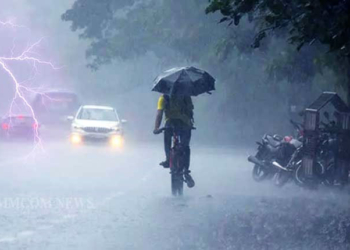







Bhubaneswar: Odisha will host a two-day national workshop on lightning safety here on October 15 and 16 to explore scientific, technological and administrative measures to reduce lightning-related deaths and damage, an official statement said.
The workshop, to be held at Hotel Lemon Tree Premier, will bring together experts from national scientific institutions, universities, disaster management agencies and district administrations to strengthen lightning forecasting, risk assessment, early warning systems and community-level preparedness.
The Revenue and Disaster Management Minister will attend the inaugural ceremony.
The first day of the workshop will focus on improving lightning detection, monitoring and forecasting through satellite data integration, numerical weather prediction, artificial intelligence (AI) and machine learning (ML) applications, and panchayat-level decision support systems.
Experts from institutions, including the India Meteorological Department (IMD), Indian Institute of Tropical Meteorology (IITM), National Remote Sensing Centre (NRSC), National Centre for Medium Range Weather Forecasting (NCMRWF) and IIT Bhubaneswar, will share their expertise, alongside researchers and representatives of universities and other technical organisations.
The discussions will explore ways to improve forecast accuracy, extend warning lead times and ensure that scientific information informs decision-making at the local level.
The second day will focus on practical interventions to prevent lightning-related fatalities and injuries. The agenda includes preparing a lightning risk mitigation roadmap for Odisha, identifying high-risk areas, developing risk-mapping methodologies, assessing risks to farmers, strengthening lightning protection standards, setting up low-cost lightning shelters and improving emergency management for lightning-strike victims.
A dedicated session will examine ways to convert scientific forecasts into timely, actionable warnings for farmers, schools, outdoor workers and vulnerable communities. The discussions will cover the use of SMS alerts, mobile applications, interactive voice response systems (IVRS), sirens, local announcements and community networks to improve last-mile warning dissemination.
The workshop is also expected to facilitate the preparation of a draft Lightning Safety Standard Operating Procedure (SOP) and a proposed action plan for 2027. The framework will seek to define warning levels, assign responsibilities to departments and administrative authorities, establish emergency response protocols and set measurable indicators to monitor implementation.
The key expected outcome is a document titled “Lightning-Safe Odisha: 2027 Action Plan and 2027–2030 Roadmap”, which will provide a framework for coordinated action on forecasting, vulnerability reduction, public awareness, warning dissemination and emergency response.
The initiative aims to bridge the gap between scientific research, government planning and community-level action, with particular emphasis on protecting farmers, agricultural labourers, outdoor workers, students and people living in lightning-prone areas.
The Odisha State Disaster Management Authority (OSDMA) has been working to strengthen the state’s disaster preparedness and response mechanisms to manage different types of disasters effectively.