





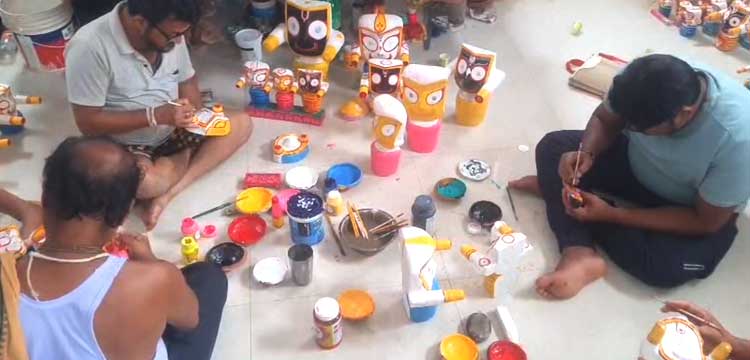
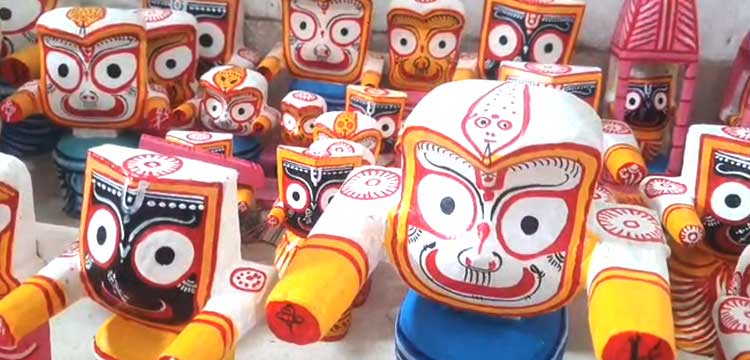
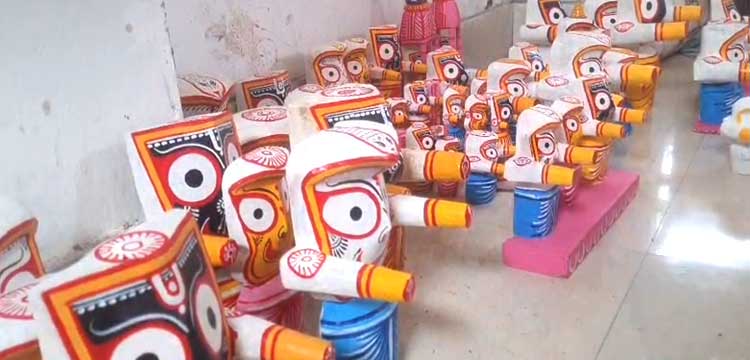
Dhenkanal: Every year during the Anasara period, when deities of Lord Jagannath, and sibling deities Lord Balaram and Devi Subhadra are believed to remain away from public view for ritual recuperation after Debasnana Purnima, devotees from across Dhenkanal bring their household idols of Lord Jagannath and His sibling deities to the historic Balaram Temple to be repainted and adorned.
The delicate task of restoring the deities’ colours and giving them a fresh, radiant appearance rests with veteran sevayat and artisan Bijay Kumar Mohapatra, whose family has been carrying forward the sacred tradition for three generations.
For Mohapatra, the work is far more than craftsmanship. It is an act of devotion inherited from his forefathers. A resident of Panchu Bati village under Siminai Panchayat in Udapada block, he says his family has remained in the service of Lord Balaram since the days of his great-grandfather.
“We have been serving the Lord for three generations and will continue as long as we live. Today, the sons and grandsons of our three brothers also participate in the rituals and services,” he says.
The Anasara period is particularly significant for the family. Apart from performing rituals for the presiding deity of the temple, they repaint and decorate household deities brought by devotees from different parts of Dhenkanal. The seasonal work provides an additional source of income while helping preserve a long-standing religious tradition.
Mohapatra, however, says the financial rewards of temple service remain modest. According to him, the remuneration provided by the temple administration is limited to rice under the traditional khorakh system, a small cash allowance and materials required for daily rituals and offerings.
“The salary is very low. What we receive is not enough to support a family. Even when we raise the issue, it receives little attention,” he says, adding that the cost of colours, spices and other ritual materials has increased considerably over the years.
Despite the challenges, he has no intention of giving up the service. He says the spiritual fulfilment associated with serving Lord Balaram outweighs financial hardship.
According to Mohapatra, the family’s ritual responsibilities begin from Debasnana Purnima, when they first touch the deity as part of the Anasara rituals. From then until Bahuda Yatra, they remain within the temple premises, strictly observing traditional religious disciplines, partaking only of temple prasada and dedicating themselves entirely to the service of the deity.
“There is immense joy in serving the Lord. We spend the entire period immersed in rituals and take leave only after Bahuda,” he says.
Even as changing economic realities make temple service increasingly difficult, Mohapatra’s family continues to uphold a centuries-old tradition, ensuring that both the presiding deity of the Balaram Temple and the household deities entrusted by devotees emerge from the Anasara period adorned in renewed splendour—a living testament to faith, craftsmanship and unwavering devotion.