





New Delhi: How feasible the proposed China-Myanmar-Bangladesh Economic Corridor (CMBC) will be is a question being raised by certain sections in Dhaka, as per reports.
China has already involved itself in infrastructure projects under the ambitious Belt and Road Initiative (BRI) in Pakistan, Sri Lanka, Nepal, and Afghanistan in the region, where progress has been mixed. Beijing is facing credibility issues due to unfulfilled promises and local resistance.
The CMBC has introduced another contention.
A recent article in Bangladesh’s The Daily Star newspaper has argued that the CMBC project looks attractive on paper, but may not be a possibility right now. It cited Foreign Minister Khalilur Rahman’s statement on June 27, when speaking to the media, that Bangladesh was “currently examining” the proposal and had “taken no position” on it.
The article noted that the core problem lies in Myanmar’s Rakhine State, where the junta has lost effective control. According to the analytical piece, the minister also said that any overland connectivity through Myanmar would remain explicitly conditional on the restoration of peace and stability in Rakhine State.
While maintaining that the CMBC remains a potentially important long-term initiative, the article noted: “For now, however, its prospects are shaped less by diplomatic agreements than by the realities inside Myanmar”.
The article also emphasised that “Until those conditions change, Bangladesh’s immediate priorities are likely to remain the bilateral projects that can move forward today while continuing to evaluate the corridor as a longer-term possibility rather than a near-term development strategy”.
The Arakan Army, an ethnic armed organisation in the Rakhine State seeking greater autonomy and now controlling most of the region, including 14 of 17 townships, leaving the military clinging to Kyaukphyu, Sittwe, and Manaung, it stressed, adding that Kyaukphyu, the proposed deep-sea port site, is under siege, with skirmishes going on within two kilometres of the junta’s naval bases.
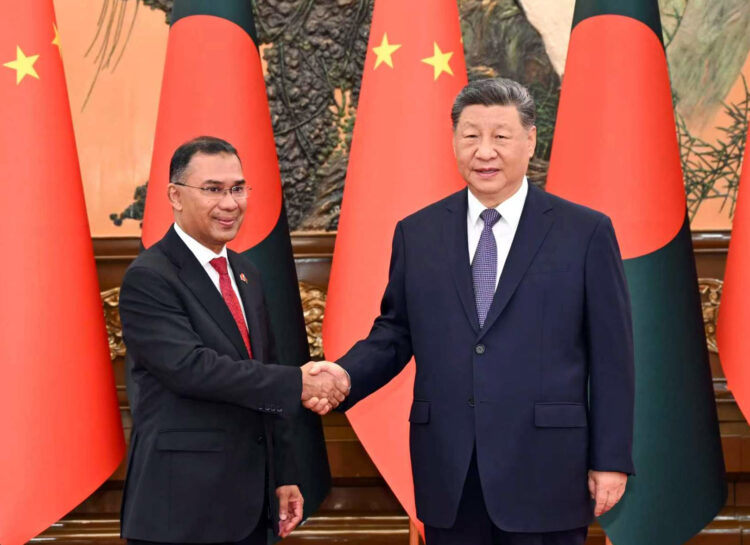
Following the recent visit of Bangladesh Prime Minister Tarique Rahman, China has reportedly proposed to connect Myanmar’s Rakhine State to the Chittagong and Cox’s Bazar regions through road and railway networks. But the region now lies largely outside the effective control of Myanmar’s military government. Chinese-backed projects have already been dismantled or suspended due to insecurity, illustrating the operational risks.
“Taken together, these constraints suggest that the corridor is unlikely to become operational in the foreseeable future. Even if fighting subsides within the next few years, financing is secured, and construction proceeds without major interruptions, the Muse-Mandalay railway alone would likely require close to a decade to complete,” the article noted bluntly.
It also linked the corridor to the contentious Rohingya issue. With fighting worsening, Dhaka sees the corridor as politically and diplomatically fraught.
“For Bangladesh, the corridor is closely linked to the Rohingya crisis. Dhaka has consistently argued that progress on regional connectivity should be accompanied by conditions that allow the safe, voluntary and dignified return of around 1.2 million Rohingya refugees currently living in Bangladesh, whose numbers have continued to grow as people flee renewed violence in Rakhine State,” it analysed.
China’s persistence in Myanmar echoes its aspirations in Afghanistan. Several reports point out that Beijing’s interest there is not just economic expansion but also security-driven. It is aimed primarily to prevent Uyghur secessionists from finding sanctuary across its tiny but unstable borderlands with Afghanistan.
In Pakistan, meanwhile, Chinese officials working in BRI projects have been targeted reportedly by separatists. Attacks have continued against Chinese engineers, infrastructure, and diplomatic sites despite scaling up security arrangements, army presence, and stringent counterterrorism measures.
China seems willing to risk investment and diplomatic capital to secure strategic depth, even against such threats, perhaps it its encircling strategy in South Asia.
In Nepal, infrastructure projects close to the strategic “Siliguri corridor” or “Chicken’s Neck” reflect motives beyond economic cooperation. In Afghanistan, the question is whether it represents an attempt to contain Uyghur networks or simply a broader expansion of China’s Belt and Road footprint. Taken with Myanmar, it suggests that Beijing’s calculus blends using economic corridors as tools of influence, and security buffers against challenges to its authority outside or within.
China’s willingness to take risks in Myanmar, despite setbacks in Pakistan, reflects a pattern that is beyond trade via corridors; it is also about controlling the geopolitical environment around the region. Meanwhile, the CMBC appears stalled by Myanmar’s fragmentation and Dhaka’s current diplomatic and political stand.
(IANS)