





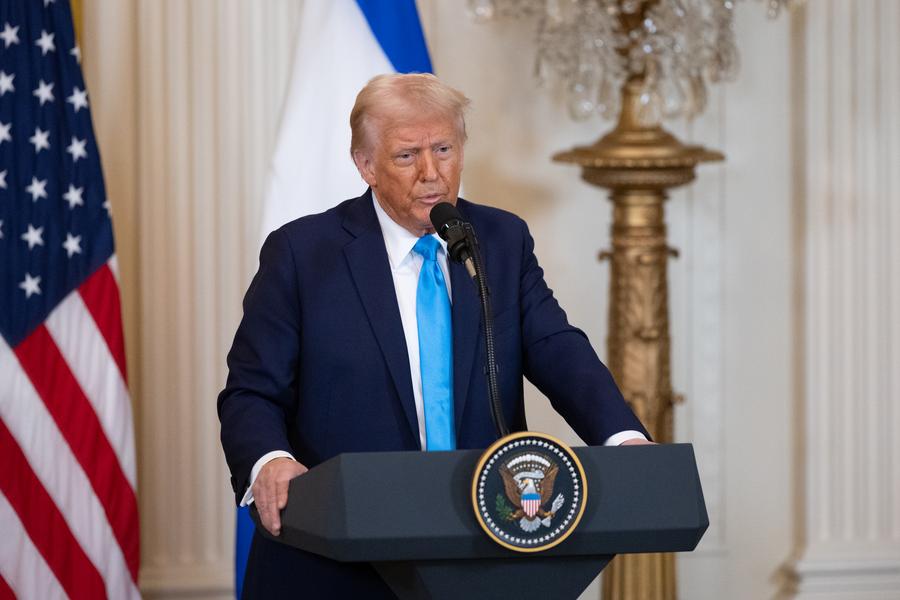
Washington: US President Donald Trump has said that the Strait of Hormuz would reopen immediately upon the signing of a proposed agreement with Iran, signalling what he described as progress in negotiations aimed at preventing Tehran from obtaining a nuclear weapon and potentially easing tensions in one of the world’s most strategically important waterways.
The remarks came as Trump outlined his administration’s efforts to reach a new understanding with Iran following recent military confrontations and diplomatic negotiations.
“Immediately upon signing the memorandum of understanding, the Hormuz Strait will open, and it will open up quickly,” Trump said during remarks at the White House on Wednesday (local time).
He added that US forces had already deployed minesweeping capabilities in the region and that most suspected mines had been cleared. “The Hormuz Strait will open immediately upon signing.”
The Strait of Hormuz, which connects the Persian Gulf to global shipping lanes, is one of the world’s most critical energy chokepoints. A significant share of global oil and liquefied natural gas exports passes through the narrow waterway, making any disruption a major concern for energy-importing nations, including India.
Trump indicated that negotiations with Iran were advancing and suggested that an agreement could be reached within days.
“I hear the negotiation itself has gone very well, actually. Very well,” he said. Asked about the timeline for a deal, Trump added: “If it happens and it might not happen, you know, who knows? But if it happens, it could happen like over the weekend.”
The President repeatedly emphasised that the central objective of the negotiations was to ensure that Iran never acquires a nuclear weapon.
“We will not have a nuclear weapon or bomb. We will not develop one, we will not buy one,” Trump said, describing what he characterised as the core commitment sought from Tehran under the proposed agreement. “Under our deal, they will never, ever have a nuclear weapon.”
In one of his most notable comments, Trump suggested that the United States and Iran could work together to remove and destroy nuclear-related material remaining at Iranian sites.
“As it stands now, we will go in and sometime in the not too distant future,” Trump said. “As of this moment, it’s agreed that we will go in with them, we will get it, and we will destroy it. It will be destroyed.”
Trump said the understanding followed recent US military action against Iranian nuclear facilities and other strategic targets.
“The B-2 bombers did a job like nobody’s ever seen,” he said, arguing that the strikes had severely damaged Iran’s nuclear infrastructure. He maintained that any remaining material would be difficult to access but insisted he still wanted it removed and destroyed under a future agreement.
While acknowledging that tensions remained high, Trump suggested that recent exchanges between the two sides should not derail negotiations.
“We hit them very hard on something else unrelated. And so they were responding,” he said. “But as far as getting it is very — the B-2 bombers did a job like nobody’s ever seen.”
The President also disclosed what appeared to be an unprecedented diplomatic opening involving Hezbollah, the Iran-backed Lebanese group.
“We actually spoke with Hezbollah for the first time ever,” Trump said. “They agreed yesterday they’re not going to shoot, Israel is not going to shoot. We’re just going to see.” He added that he would prefer to keep discussions involving Iran separate from broader regional conflicts.
Trump praised Israeli Prime Minister Benjamin Netanyahu as “a great partner” and argued that joint US-Israeli actions had prevented a broader regional crisis.
“I stopped it, and I’m very proud I stopped it,” Trump said, referring to what he described as Iran’s military ambitions and regional activities.
The President contrasted the proposed agreement with the nuclear accord negotiated during the Obama administration, calling the earlier deal “a disgrace” and arguing that the new arrangement would permanently block Iran’s path to a nuclear weapon.
Trump indicated that economic considerations had weighed heavily on his decision-making. He said he had been concerned about the impact of military action on financial markets but was encouraged by subsequent market performance.
“We have the highest stock market in history,” he said, adding that the United States had nevertheless been prepared to take what he called a “detour” to prevent Iran from obtaining a nuclear weapon.
(IANS)