





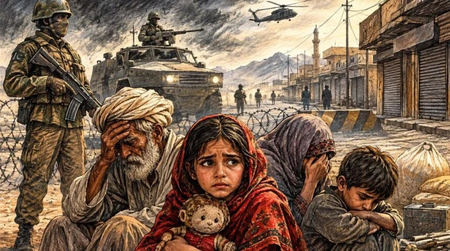
New Delhi: Pakistan’s airstrikes on people it calls its own crosses a moral and political line that civilised societies refuse to breach, yet remains with many precedents.
It has reportedly carried out airstrikes in Balochistan’s Surab district on Wednesday that is said to have killed more than 30 civilians, including women and children, and injured several others.
Nearly a year ago, the Pakistani Air Force carried out similar bombing at a village in Khyber Pakhtunkhwa province that left almost a similar number dead.
Pakistan has a history of using military force against its own population, most infamously during the 1971 crackdown in East Pakistan — now Bangladesh — and currently in the tribal regions where airstrikes and artillery are being used against “suspected militants”, but killing civilians instead.
These incidents highlight the devastating consequences when a state turns its military power within.
The worst such incident was reported in 1971 when Islamabad unleashed “Operation Searchlight” in East Pakistan with tanks, artillery, and airstrikes to suppress Bengali nationalist movements after the Awami League’s electoral victory.
Widespread atrocities by the Army and those supporting the operation included mass killings, rape, and targeting of intellectuals.
The number of casualties estimated from the carnage totals several lakhs of civilians killed over nine months, and the country, since independence, still commemorates March 25 as “Genocide Day”.
And well over the past decade, Pakistan’s military has conducted repeated airstrikes in the tribal areas, again, against alleged Taliban and Al-Qaeda militants.
However, civilian casualties are frequently reported, with villages bombed under suspicion of harbouring insurgents.
Human rights groups have criticised the indiscriminate nature of these strikes, which killed scores and displaced thousands.
Instead of sitting at the negotiating table, the bombings further fuel insurgency, deepen ethnic divides, and destabilise regions.
Additionally, there are records establishing Pakistan’s military using villages and civilian settlements as firing positions during wars against India in 1965 and 1971, and continues along the Line of Control in Kashmir.
With this, Islamabad chooses to blur the line between civilian and military zones, exposing non-combatants to retaliatory fire.
The Geneva Conventions explicitly prohibit the use of civilian areas for military purposes, so that civilians are protected from becoming targets in armed conflicts.
In recent times, Pakistan has targeted Afghan territories with airstrikes, drawing condemnation.
Carried out again under the garb of targeting terrorists, such bombings have killed several innocent Afghan, destroyed homes, and uprooted hundreds of families.
Civilised states avoid such brutality because it destroys legitimacy, violates international norms, and leaves scars that last generations.
Perhaps the closest example of such action in the region comes from Myanmar, where airstrikes on civilians are documented by UN investigators and released on Tuesday.
It reflects the devastation caused to homes, schools, hospitals, and displacement camps, killing innocents under the guise of fighting “terrorists”.
Incidentally, in the final phase of its civil war around 2009, Sri Lanka’s government forces, too, had allegedly shelled civilian zones, sparking allegations of war crimes.
Meanwhile, in Myanmar’s Rakhine State alone, 20 civilians were killed in a single month of airstrikes, say reports.
“Expanded military operations include indiscriminate attacks on civilians through airstrikes, with the junta targeting schools, hospitals, religious sites, as well as displaced person camps. The military has also made use of drones, as well as motorised paragliders, used to drop bombs,” the United States Committee for Refugees and Immigrants noted earlier this year.
This is terror from above, designed to break a country’s own communities and silence dissent.
(IANS)