






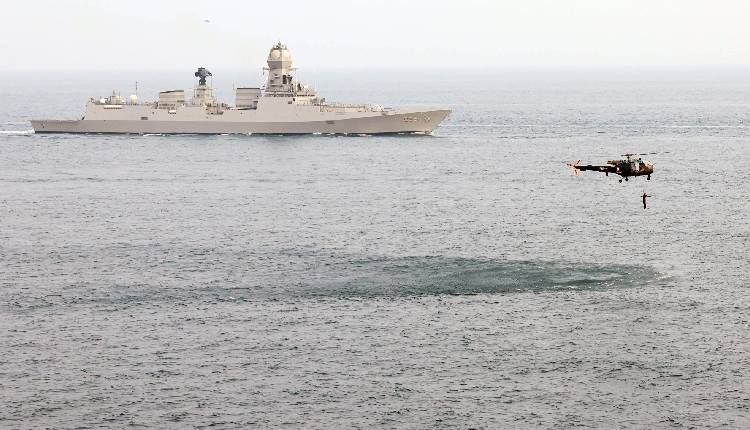
Athens: India’s ambitious Project 18 programme is steadily taking shape as what is expected to be one of the most powerful surface combatant projects ever undertaken by the Indian Navy, according to a recent report.
The report by Greek City Times noted that the next-generation destroyer is evolving into a much larger cruiser-class warship designed to meet the demands of future maritime warfare.
The proposed platform has expanded significantly in size and capability compared to existing Indian destroyers, according to the recent report.
It suggested that the warship’s displacement is now expected to range between 11,000 and 13,000 tonnes at full load, while its overall length could reach approximately 180 metres, placing it in a category well above the Navy’s current frontline destroyers.
It indicates that the vessel will be powered by an Integrated Electric Propulsion (IEP) system, a technology considered critical for future warships because of its ability to generate large amounts of electrical power while simultaneously reducing acoustic signatures.
Such a propulsion arrangement would also provide the energy required for next-generation combat technologies, including advanced radar systems, directed-energy weapons, and other high-power equipment expected to become central to naval operations in the coming decades.
Project 18 is also expected to incorporate extensive automation throughout the ship, reducing crew requirements by an estimated 25 to 30 per cent compared to existing platforms. The reduction in manpower is intended to improve operational efficiency while lowering long-term maintenance and personnel demands.
The vessel is envisioned not merely as a destroyer but as a multi-domain command hub capable of directing and coordinating a wide range of assets within carrier battle groups.
According to the report, the ship would be able to manage operations involving unmanned aerial vehicles (UAVs), unmanned surface vessels (USVs), and extra-large unmanned underwater vehicles (XLUUVs), making it a central node in future network-centric warfare environments.
One of the most striking features highlighted in the report is the planned weapons loadout. Project 18 is expected to carry up to 144 Vertical Launch System (VLS) cells, with the possibility of additional midship slant launchers. Such a configuration would make it one of the most heavily armed warships in Asia.
The vessel is expected to feature a layered air and missile defence architecture that includes long-range surface-to-air missiles under Project Kusha, dedicated anti-ballistic missile systems reportedly capable of engaging threats at ranges of 250 to 350 kilometres, and Vertical Launch Short Range Surface-to-Air Missiles (VL-SRSAM) for point-defence duties.
On the offensive side, the report states that the warship is likely to be equipped with an array of advanced strike weapons — extended-range BrahMos missiles, long-range land attack cruise missiles (LR-LACM), SMART anti-submarine missile systems, and potentially the future BrahMos-II hypersonic missile once it becomes operational.
In addition to conventional weaponry, the platform is reportedly being designed with baseline provisions for directed-energy systems.
The report suggests that 50–100 kW shipborne laser weapons could eventually be integrated to counter drone swarms and other emerging aerial threats in a more cost-effective manner than traditional missile-based interceptors.
The sensor suite planned for the vessel is equally ambitious. According to the report, Project 18 will be equipped with an indigenous S-band Active Electronically Scanned Array (AESA) radar developed by the Defence Research and Development Organisation.
The radar is expected to replace the Israeli MF-STAR system currently used on several Indian warships and could reportedly provide surveillance coverage exceeding 500 kilometres.
The design is also expected to incorporate stealth-focused features, including a low-observable mast structure, advanced electronic warfare systems and sophisticated multi-domain battle management capabilities intended to enhance survivability and situational awareness in contested environments.
The report further notes that the Indian Navy is considering an initial production run of four to five vessels under Project 18, with the possibility of expanding the programme to between 10 and 12 ships in the future, depending on operational requirements and budgetary considerations.
Among Indian shipbuilders, Mazagon Dock Shipbuilders Limited and Garden Reach Shipbuilders & Engineers are reported to be the leading contenders for constructing the vessels.
The report also states that an interim Project 15C programme, based on an upgraded version of the Visakhapatnam-class destroyer, may be pursued to sustain industrial activity and maintain shipbuilding momentum while Project 18 continues to mature through its design and development phases.
Project 18 would represent a major leap in India’s naval capabilities, combining large displacement, long-range strike power, integrated air and missile defence, advanced sensors, unmanned systems integration and future-oriented technologies.
The Indian Navy is actively modernising to counter multi-domain, networked threats through a massive Builder’s Navy transformation. This shift focuses heavily on indigenous stealth warships, next-generation submarines, artificial intelligence (AI) integration, and expanding blue-water combat capabilities to project power across the Indo-Pacific.
Project 18 also reflects the Indian Navy’s long-term vision for blue-water operations and strategic power projection across the Indo-Pacific region.
(IANS)