





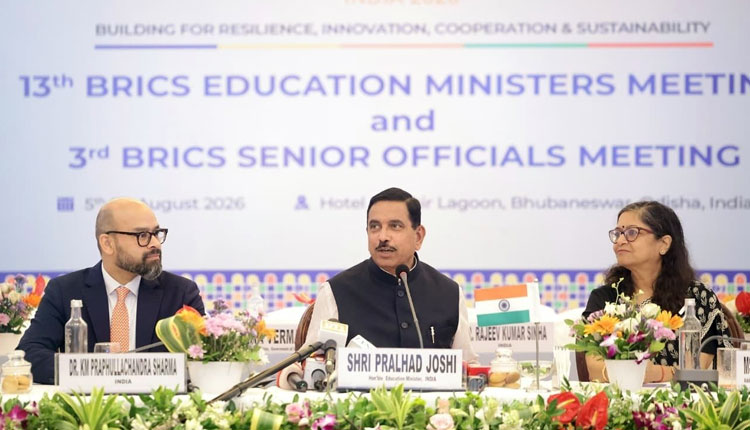
Bhubaneswar: Union Education Minister Pralhad Joshi on Friday urged BRICS countries to tackle education challenges collectively, saying resilience, innovation and sustainability cannot be achieved in isolation.
Chairing the 13th BRICS Education Ministers’ Meeting, Joshi said India’s chairship of BRICS in 2026 is guided by four key principles: resilience, innovation, cooperation and sustainability. The meeting concluded with the adoption of a five-point BRICS Education Ministers’ Declaration.
“More of us can meet these challenges, but none of us can address them in isolation,” Joshi said. “The knowledge we create, the technology we develop and the institutions we strengthen must serve not only the present generation but also the generations to come.”
The minister said education systems must be resilient enough to withstand disruptions from pandemics, economic uncertainties, climate change and rapid technological change. He added that innovation is essential for education to keep pace with a fast-changing world and to prepare young people for jobs and opportunities that do not yet exist.
At the same time, he stressed that education must remain rooted in human values, with learners, teachers and researchers at the centre of policymaking. Joshi also underlined the importance of preserving traditional and indigenous knowledge systems.
“The rich civilisational traditions of BRICS nations present a unique opportunity to preserve traditional knowledge, study it rigorously, and pass on its value to future generations,” he said. Reaffirming India’s commitment to a ‘people-centric’ and ‘humanity-first’ approach, he described education as the foundation of inclusive growth and shared prosperity.
The declaration outlines five priority areas for BRICS cooperation: First, strengthening Early Childhood Care and Education and Foundational Literacy and Numeracy. Member nations agreed to promote universal access to quality ECCE, improve school readiness, and use age-appropriate digital tools for early learning.
Second, skill development and TVET. The declaration acknowledged India’s proposal for an International Skill Gap Study, with voluntary participation from BRICS countries.Third, enhancing research, innovation and start-up ecosystems. The group will promote joint research, encourage safe and ethical use of Artificial Intelligence in education, and deepen collaboration among universities, researchers and start-ups.
Fourth, mutual recognition of qualifications to enable greater student and professional mobility across BRICS nations.
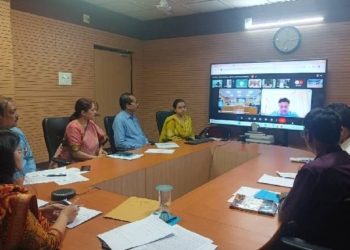
Fifth, capacity building for academic leadership and institutional development. Ministers and senior officials from Brazil, Russia, China, South Africa, Indonesia, Iran, Ethiopia and the UAE attended the meeting under the BRICS Education Track. Ahead of the ministerial, the Ministry of Education hosted the 3rd BRICS Senior Officials’ Meeting on August 5 as part of India’s BRICS Chairship.
India will host BRICS ministerial meetings across various sectors during its chairship, culminating in the 18th BRICS Summit scheduled for September 12-13, 2026 in New Delhi.