





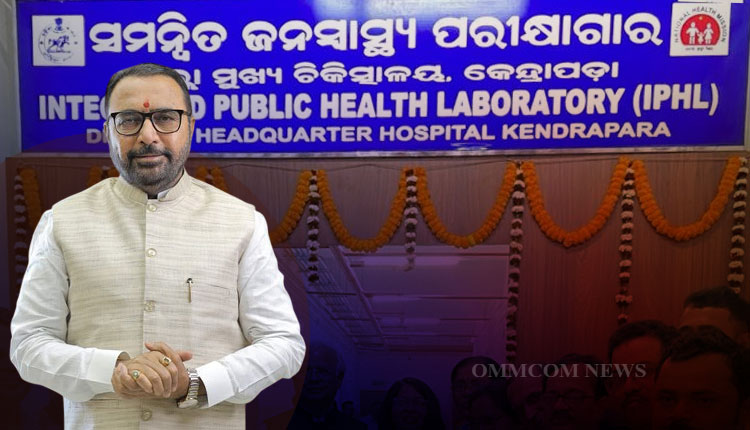
Bhubaneswar: Thirty Integrated Public Health Laboratories (IPHLs) are operational across Odisha, with one in each district, while District Surveillance Units (DSUs) are functioning in all 30 districts to strengthen disease surveillance and response, Union Minister of State for Health and Family Welfare Prataprao Jadhav informed the Rajya Sabha on Tuesday.
In a written reply to a question by BJD Rajya Sabha MP Sasmit Patra, Jadhav said 30 IPHLs had been approved in Odisha under the Centrally Sponsored Scheme component of the Pradhan Mantri Ayushman Bharat Health Infrastructure Mission (PM-ABHIM).
The state has 64 microbiologists, while diagnostic services are being provided in accordance with the Indian Public Health Standards (IPHS), the minister said.
Odisha also has six functional Viral Research and Diagnostic Laboratories (VRDLs) under the Department of Health Research (DHR), Ministry of Health and Family Welfare.
The six laboratories are located at the ICMR-National Institute of Health Research, Bhubaneswar; Srirama Chandra Bhanja Medical College and Hospital, Kataka; AIIMS Bhubaneswar; Saheed Laxman Nayak Medical College and Hospital, Koraput; Veer Surendra Sai Institute of Medical Sciences and Research, Burla; and Maharaja Krushna Chandra Gajapati Medical College, Berhampur.
The VRDLs have sanctioned manpower ranging from six to eight personnel and annual diagnostic capacities of 3,000 to 8,000 tests. Depending on their respective levels, the laboratories are equipped with molecular, serological and culture facilities.
The minister said laboratory infrastructure in Odisha is assessed through the National Quality Assurance Standards (NQAS) and monthly surveillance under the Kayakalp programme. Infrastructure under PM-ABHIM is also being strengthened, while DSUs in all districts are engaged in disease surveillance and response to unusual events.
Under the VRDL scheme, laboratory infrastructure and disease surveillance capabilities are periodically reviewed. The assessments cover equipment, testing facilities, manpower, diagnostic workload, quality management systems, biosafety, training and outbreak-response capabilities.
Gaps identified during these assessments are addressed through infrastructure upgrades, additional equipment, human resources, training and technical support, Jadhav said.
The Centre has also undertaken several measures to strengthen Odisha’s preparedness for emerging and re-emerging infectious diseases. These include strengthening State and District Surveillance Units under the Integrated Disease Surveillance Programme (IDSP), real-time disease surveillance through the Integrated Health Information Platform (IHIP), and the formation and training of Rapid Response Teams.
Other measures include strengthening Integrated Public Health Laboratories, expanding diagnostic facilities, capacity building of health personnel, dissemination of standard operating procedures and disease-specific guidelines, and inter-sectoral coordination under the One Health approach.
Regular reviews and supportive supervision, along with risk communication and Information, Education and Communication (IEC) activities, are also being carried out to improve preparedness and response.
The VRDL network is further being strengthened through expansion of molecular, serological and genomic diagnostic capacities, improvement of laboratory infrastructure, biosafety and quality management systems, capacity building of scientific and technical manpower, and better coordination for sample referral and confirmatory testing during disease outbreaks.