





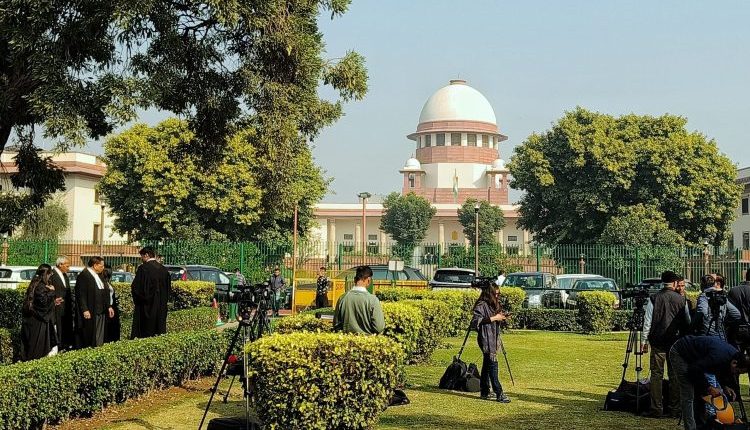
New Delhi: The Supreme Court has upheld the conviction and life sentence awarded to a man in a 1998 murder case from Gujarat, ruling that the conviction can be sustained on the basis of reliable testimony of even a solitary witness, despite several prosecution witnesses turning hostile during the trial.
A bench of Justices Aravind Kumar and Prasanna B. Varale dismissed the appeal filed by Mitesh alias T.V. Vaghela against the Gujarat High Court judgment affirming his conviction under Section 302 of the Indian Penal Code and Section 135 of the Bombay Police Act.
The trial court had sentenced the appellant to life imprisonment along with a fine of Rs 500 for the offence of murder. He was also awarded 10 days’ rigorous imprisonment and a fine of Rs 250 under the Bombay Police Act.
As per the prosecution’s case, the incident arose out of a quarrel on December 11, 1998, after the accused allegedly threw a half-burnt cigarette into a bucket used by Somabhai Rabari for washing tea cups and saucers at his tea stall in Ahmedabad’s Khokara area. The following morning, Rabari was found lying in an injured condition near his tea stall.
His brother, complainant Ishwarbhai Rabari, stated that upon reaching the spot, Rabari informed him that Mitesh had stabbed him.
According to the prosecution, Rabari repeated the allegation while being taken to the hospital in an autorickshaw, where he was later declared dead. During the investigation, police recovered the alleged weapon of offence — a knife — pursuant to information furnished by the accused.
Before the apex court, the appellant argued that the prosecution’s case was unreliable since several independent witnesses and panch witnesses had turned hostile, and the alleged oral dying declaration could not be relied upon.
It was also contended that the deceased was not in a fit condition to make any statement due to the injuries suffered by him.
Rejecting the contention, the Supreme Court said the prosecution had succeeded in proving the case beyond a reasonable doubt. “The legal position with regard to dying declarations is no longer res integra. It is well settled by a catena of decisions of this Court that a truthful and voluntary dying declaration, if found to be reliable, can by itself form the sole basis of conviction without the necessity of corroboration,” the Justice Aravind Kumar-led Bench observed.
It further said that the testimony of the complainant regarding the oral dying declaration remained unshaken during cross-examination and stood corroborated by prosecution witness Mukeshbhai Kuberbhai, an autorickshaw driver who claimed to have witnessed the assault.
The judgment recorded that the prosecution witness had consistently deposed that he saw the accused inflict a knife blow on the deceased during a quarrel and flee from the spot with the weapon in his hand.
“The witness has given a clear, cogent, and consistent account of the occurrence and has withstood the test of cross-examination without any material contradiction or infirmity being brought on record so as to discredit his presence or his version,” it said.
The Supreme Court further held that the mere fact that several witnesses turned hostile would not demolish the prosecution’s case if reliable evidence establishing guilt was otherwise available on record.
“It is a settled principle of criminal jurisprudence that it is the quality and not the quantity of evidence which is determinative. Even the testimony of a solitary witness, if found to be wholly reliable and of sterling quality, is sufficient to base a conviction,” the bench said.
Referring to its earlier judgment, the top court reiterated that Indian law does not require a particular number of witnesses for recording a conviction. “Our legal system has always laid emphasis on value, weight and quality of evidence rather than on quantity, multiplicity or plurality of witnesses,” the judgment added.
Finding no infirmity in the concurrent findings of the trial court and the Gujarat High Court, the apex court dismissed the appeal.
However, taking note of the fact that the appellant had already undergone a substantial part of the sentence, the Supreme Court granted liberty to him to move an application seeking remission in accordance with the applicable policy.
(IANS)