




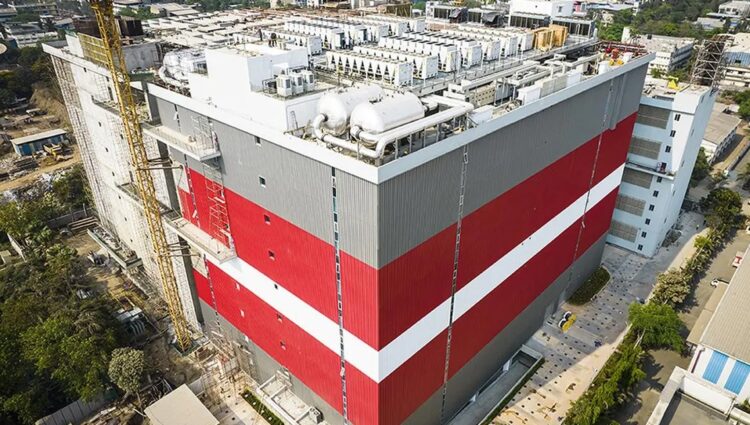
New Delhi: India’s data centre capacity is set to surge nearly six fold from 1.8 GW to about 10.5 GW by FY2031 as demand rises due to artificial intelligence adoption and data localisation policies, a new report has said.
The report from investment bank Morgan Stanley said AI workloads alone could account for roughly 6.8 GW of the projected capacity and that rising demand for low latency processing, tighter localisation norms and increasing compute intensity are another major driver.
Further, geopolitical realignments, and India’s regulatory push, are catalysing a multi-year investment cycle in data centres, the report said.
The report projected an industrial capital expenditure pipeline of around $60 billion linked to incremental data centre capacity, covering land, power systems, cooling infrastructure and networking equipment.
It said the power ecosystem will require over $20 billion of investment to support energy intensive facilities, with operators increasingly shifting towards renewable energy and storage solutions.
The report highlighted that policy measures such as data localisation stipulations, infrastructure status for data centres and fiscal incentives are accelerating capital formation and attracting global hyperscalers.
“Strategically, greater domestic data storage enhances digital sovereignty, reduces reliance on overseas infrastructure, and positions India as a regional hub for global technology firms,” the report said, adding foreign investment flows will deepen, positioning India as a regional hub for cloud and digital services.
The report also flagged constraints to such a rapid scaling, which are access to reliable and cost-effective power, and India’s dependence on imported high-end computing hardware.
Morgan Stanley said that about 60 per cent of the incremental capex in India through 2030 is likely to be allocated to energy transition, data centres and defence.
India is likely to see an incremental cumulative capex of $800 billion over the next five years in these sectors due to the Middle East conflict, and the country’s investment rate will touch 37.5 per cent of GDP in FY2030, the report said,
(IANS)