





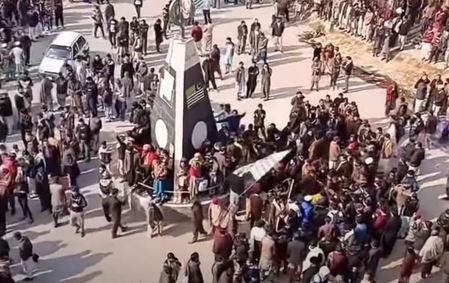
New Delhi: The ongoing unrest in Pakistan-occupied Jammu and Kashmir (PoJK) is not a sudden flare-up, but the culmination of decades of political marginalisation, economic injustice, and reprisal, meted out by the political and military masters in Islamabad and Rawalpindi.
While Pakistan projects PoJK as “independent” or “free”, the reality is starkly different. It has always been under the masters’ thumb, with a skewed representation in governance and regular crushing of dissent. Skirting real issues and core grievances, regular crackdowns are conducted against any form of dissent by Pakistani security agencies.
“We don’t want charity; we want justice. This land produces electricity, but our homes remain dark,” reports quoted a protestor saying amidst the recent spurt in demonstrations.
PoJK is again gripped by violence, with deaths reported during protests. In June, there were reports of at least 11 deaths in Rawalakot during agitations organised by the banned Joint Awami Action Committee (JAAC). More than 70 were said to have been injured. Protests escalated after the JAAC was banned under anti-terror laws.
The JAAC, formed in 2023, has spearheaded protests against high electricity tariffs despite local hydropower generation, raised its voice over inflation and wheat flour shortages as well as on the reservation of seats for “refugees” from Pakistan that is seen as disenfranchising locals. The turmoil reflects deep-rooted grievances over economic hardship, political disenfranchisement, and Islamabad’s tight control over the region. Behind the “free” facade, PoJK in reality is not independent.
Recent incidents have once again put the spotlight on the region that remains illegally occupied by Pakistan. Though it has its own Prime Minister, President, Legislative Assembly, Constitution and flag, it remains under the control of Islamabad and Rawalpindi.
Its “Interim Constitution” explicitly requires allegiance to Pakistan by mandating that all candidates, legislators, and officeholders must affirm loyalty to Pakistan and the ideology of accession. Candidates for the Legislative Assembly, Prime Minister, or President must sign an oath affirming loyalty to Pakistan and support for accession, while any party or individual advocating independence or union with India is disqualified from contesting elections.
The Prime Minister is elected by the Legislative Assembly, but only pro-Pakistan candidates are allowed to contest. Moreover, out of the 53 seats, 12 are reserved for “refugees” from Jammu and Kashmir who migrated to Pakistan in 1947 and later. However, these seats are filled by Pakistan-based voters, not residents of PoJK – many of whom are alleged agents of the security agencies – giving Islamabad disproportionate influence.
While PoJK wears an outer fabric of autonomy, its governance is tightly controlled by Pakistan’s federal government. Islamabad retains ultimate authority, with the PoJK Council, dominated by Pakistani officials, exercising veto powers. The Council, chaired by the Prime Minister of Pakistan, historically exercised veto powers over legislation. Though reduced in the 2018 reforms, Islamabad still controls its foreign affairs, defence, and currency. It is thus not really an independent state.
The political spectrum of PoJK is dominated by the colours of mainstream Pakistani parties, and voters cannot elect candidates who oppose Pakistan’s control. The allegiance clause is reportedly one of the reasons for the ongoing unrest in PoJK, where residents feel disenfranchised. Their representatives are legally bound to Pakistan, not to local aspirations, while “refugee seat reservations” dilute local voices and demand for better healthcare, education, and infrastructure is met with reprisal.
Food shortages and higher electricity tariffs despite local hydropower generation are among common economic grievances that compound political frustration.
Pakistan occupied parts of Jammu and Kashmir during the first war with India. Since then, PoJK has remained under Pakistani control. Limited autonomy was granted between 1970 and 1980, but Islamabad retained veto powers.
Meanwhile, economic grievances grew, more so since 2015, especially over electricity pricing and lack of development. For the last three years, protests have flared further. Off and on, Islamabad offers some subsidies and compensation under its carrot-and-stick policy, but shuns real issues.
(IANS)