





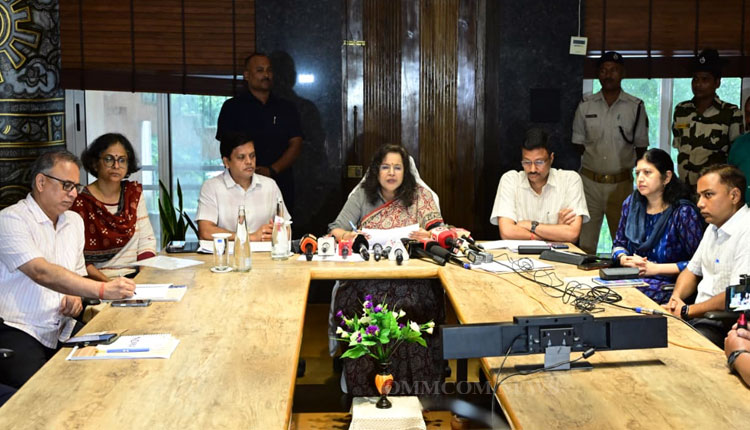
Bhubaneswar: Odisha Chief Secretary Anu Garg today reviewed the prevailing flood situation and the preparedness and response measures undertaken by various departments and district administrations as heavy rainfall continued to affect several parts of the state.
At a high-level review meeting held at the office of the Special Relief Commissioner, the Chief Secretary directed concerned departments and District Collectors to take all necessary and immediate measures to ensure the safety of people in flood-affected areas.
According to the India Meteorological Department (IMD), rainfall activity in northern Odisha is likely to intensify as a low-pressure area over the north Bay of Bengal and adjoining areas of West Bengal and the north Odisha coast is expected to strengthen over the next 24 hours.
Baleshwar, Bhadrak, Jajpur, Mayurbhanj and Kendujhar have been placed under a Red Warning, while most other districts are under an Orange Warning. Some districts remain under a Yellow Warning. Rainfall is likely to continue in the affected northern districts until August 18, after which its intensity is expected to decrease.

The current spell of flooding has affected 49 blocks, 331 Gram Panchayats, 947 villages and five urban areas, with around 5.15 lakh people affected, according to information presented at the meeting.
Around 2.37 lakh people have been evacuated to safe and elevated locations. District Collectors are monitoring the situation and coordinating relief and rescue operations.
Cooked food, flattened rice (chuda), jaggery and other essential commodities are currently being provided at 293 relief camps.
For rescue and emergency operations, 36 ODRAF teams, seven NDRF teams and 43 Fire Services teams have been deployed across different districts.
The Health Department has deployed Rapid Response Teams (RRTs) to medical colleges and hospitals in the affected districts. Adequate stocks of essential medicines, halogen tablets, bleaching powder and anti-snake venom injections are available and are being supplied as required.
The Chief Secretary reviewed the health situation with the Health Department Secretary and concerned District Collectors and issued necessary directions.
Flooding has disrupted power supply to around 75,000 consumers in several villages. The Energy Department said electricity connections would be restored in areas where floodwater has receded, subject to safety conditions.
Additional manpower has been deployed to expedite restoration work.
In urban areas, Rapid Action Teams are engaged in flood-management operations. Arrangements have been made for drainage and water discharge wherever necessary, while drinking water is being supplied through tankers.

The Housing and Urban Development Department has also activated emergency services and helplines to respond to flood-related requirements.
The Fisheries and Animal Resources Development Department has supplied 5,000 quintals of cattle feed for distribution in flood-affected areas under the supervision of District Collectors.
The department has deployed 36 RRTs, while 50 camps are operational. Medicines required for livestock are also being supplied.
The Water Resources Department is keeping a round-the-clock watch on embankments, particularly at vulnerable locations where breaches are likely.
Sandbags are being used at vulnerable points to control flooding. Existing breaches will be repaired at the earliest after the floodwater recedes, officials said.
An Additional Engineer-in-Chief has been deployed to Baleshwar, while senior Superintending Engineers have been sent to other affected districts.
Experienced officers with previous flood-management experience have been assigned to the worst-affected districts to assist District Collectors.
IAS officer K. Sudarshan Chakravarthy has been assigned to Baleshwar, P. Anvesha Reddy to Jajpur, and Central Range Revenue Commissioner Sudhansu Mohan Samal to Bhadrak.
The Revenue Department has also advised District Collectors to provide immediate financial assistance to people in flood-affected areas. Leave of officers in the concerned districts has been cancelled until the situation improves.
Odisha has recorded significantly higher rainfall this monsoon. From June 1 to August 16, the state normally receives an average rainfall of 759 mm. Against this, 953 mm has been recorded this year, which is 27 per cent above normal.
Nabarangpur, Gajapati and Kalahandi have received comparatively less rainfall, while the remaining districts have recorded normal rainfall or rainfall slightly above or below normal.
In view of the low-pressure-induced rainfall, the Fisheries and Animal Resources Development Department has been directed to ensure that fishermen do not venture into the sea for the next three days. District Collectors have also been instructed to enforce the advisory.
The Chief Secretary expressed concern over people gathering near river embankments to watch rising water levels and taking photographs or selfies at vulnerable locations.
She urged people to refrain from such activities and exercise extreme caution. District Collectors have been directed to conduct extensive public awareness campaigns through public-address systems to warn people about the dangers.
With heavy rainfall forecast to continue in several northern districts, the state administration has stepped up rescue, relief and preparedness measures and advised people to remain alert and follow official advisories.