





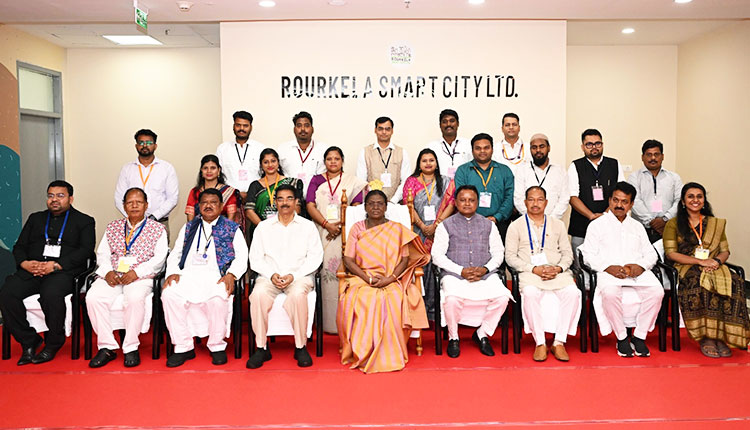
Rourkela: President of India, Droupadi Murmu on Tuesday inaugurated a series of key public infrastructure projects in Rourkela, including a planetarium, science centre, tribal museum, and an integrated command and control centre, underscoring the Centre and state’s focus on development in tribal-dominated regions.
At a public function, the President inaugurated the Planetarium and Science Centre as well as the Nirmal Munda Parivesh Path. She later dedicated the Tribal Museum and the Integrated Command and Control Centre to the public.
Addressing the gathering, Murmu highlighted the rich natural and cultural heritage of Sundargarh district, noting that its dense forests, mountains, waterfalls and rivers lend it a unique charm. She said the district’s vibrant folk traditions and cultural practices have significantly contributed to Odisha’s cultural diversity, while also describing it as a land of brave individuals and sporting talent.
The President observed that Rourkela has evolved into a cosmopolitan hub, attracting people from across India, including Odisha, in search of livelihood opportunities. She credited the city with playing a pioneering role in promoting the state’s art, literature, tribal traditions, and sports.
Emphasising inclusive growth, Murmu said the development of the nation is intrinsically linked to the progress of every section of society. She noted that both the Central and state governments are implementing multiple welfare schemes aimed at improving the socio-economic conditions of tribal communities, particularly in districts like Sundargarh.
Calling for collective participation, the President urged citizens to actively contribute to nation-building and support those left behind. She encouraged people to strive for personal growth while helping others advance.
Murmu further said that India is steadily progressing towards becoming a developed nation by 2047, marking 100 years of independence. She added that Odisha will celebrate its centenary year in 2036, and achieving the vision of a “Viksit Odisha” and “Viksit Bharat” would require inclusive and holistic development with contributions from all sections of society, including farmers, labourers, tribal communities, youth, and both urban and rural populations.