





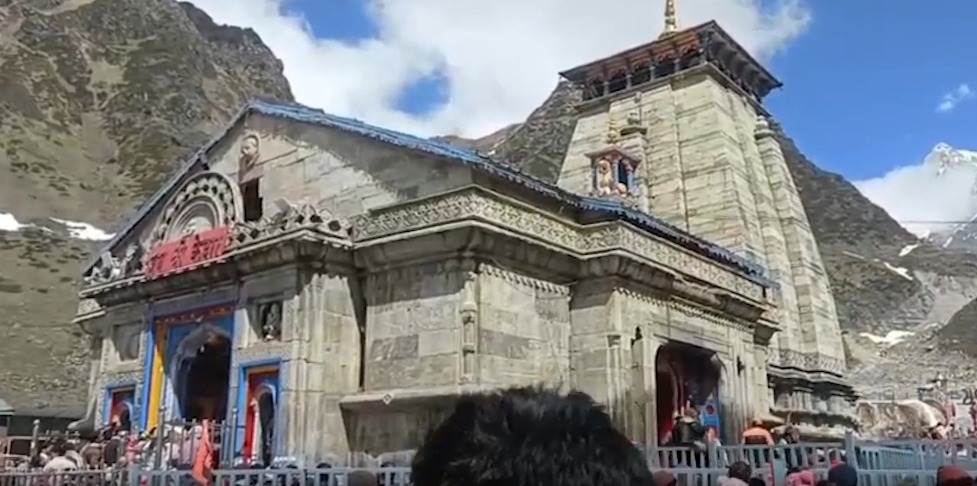
Kedarnath: The district administration has intensified eco-friendly and cleanliness measures along the Kedarnath Dham Yatra route by deploying modern waste management systems. Rudraprayag District Magistrate Vishal Mishra has urged pilgrims to actively support these cleanliness efforts.
The district administration is making continuous efforts to ensure that the pilgrimage to Shri Kedarnath Dham remains clean, green, and environmentally sustainable. With a strong focus on sanitation and solid waste management from the trekking route to the temple complex, comprehensive arrangements have been put in place.
The Kedarnath Nagar Panchayat is utilising a modern baling machine to manage dry waste efficiently. This machine compresses waste into compact bales, making transportation and recycling easier and safer.
Executive Officer Neeraj Kukreti stated that a Material Recovery Facility (MRF) centre has been set up at the Dham, where dry waste is systematically collected, segregated, and recycled. So far, around 500 kilograms of dry waste has been processed into bales, which is expected to generate revenue of Rs 15,000 to Rs 20,000.
Rudraprayag District Magistrate Vishal Mishra emphasised that special directives have been issued to maintain cleanliness in and around the shrine. Sanitation infrastructure is being strengthened along the entire pilgrimage route leading to Kedarnath. He also appealed to devotees to cooperate by avoiding littering and supporting eco-friendly practices.
Meanwhile, the Char Dham Yatra has witnessed a significant turnout this season, with more than 660,000 devotees completing the pilgrimage so far.
The Char Dham of Uttarakhand is one of the most revered Hindu pilgrimage circuits in the Indian Himalayas, located in the Garhwal region. The circuit comprises four sacred shrines—Yamunotri, Gangotri, Kedarnath, and Badrinath. These sites hold immense religious significance, with Kedarnath dedicated to Lord Shiva and Badrinath to Lord Vishnu, while Yamunotri and Gangotri are associated with the sacred rivers Yamuna and Ganga, revered as goddesses.
Traditionally, the Char Dham Yatra is undertaken from west to east, beginning at Yamunotri, followed by Gangotri, and then proceeding to Kedarnath and Badrinath. The pilgrimage was popularised by Adi Shankaracharya in the 8th century to revive Hindu spiritual traditions. Today, it continues to attract thousands of devotees from across the world, offering a deeply spiritual and enriching experience.
(IANS)