






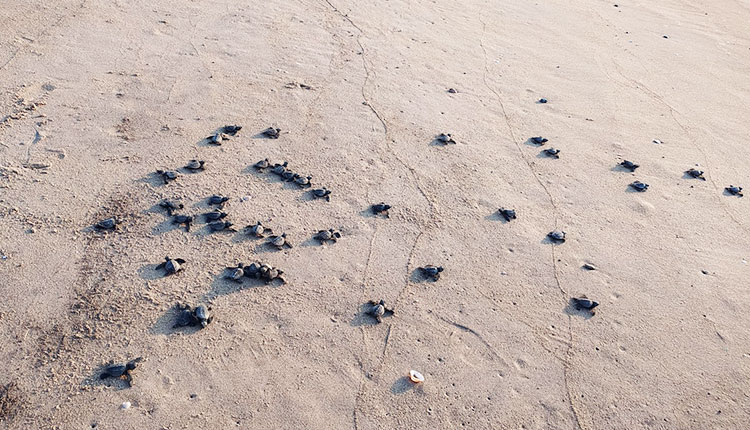
Brahmagiri (Puri): The Brahmagiri Forest Division in Puri district has recorded its highest-ever success in Olive Ridley turtle conservation, with 66,451 hatchlings safely released into the sea this season.
According to Forest Department officials, a total of 74,920 Olive Ridley turtle eggs collected from 646 nests along the Baliharachandi and Chapamanik beaches were placed in temporary hatcheries for protected incubation during the 2025-26 nesting season.
At Baliharachandi beach, forest personnel collected 25,303 eggs from 216 nests. Of these, 22,297 hatchlings successfully emerged and entered the sea, while 3,006 eggs were destroyed due to natural causes.
Similarly, at Chapamanik beach, 49,617 eggs collected from 430 nests were shifted to hatcheries. A total of 44,154 hatchlings later emerged and were safely released into the sea, while 5,463 eggs were lost.
Officials said the combined release of 66,451 hatchlings from the two beaches marks an all-time record for the Brahmagiri Forest Division.
The Forest Department carried out round-the-clock patrolling for nearly six-and-a-half months, from November 2025 till May 18, 2026, along the 26-km coastline stretching from the Puri Mangala river mouth to the Baliharachandi river mouth to ensure safe nesting conditions and prevent disturbances.
Forest officials said Olive Ridley turtles arrived safely on both beaches during the season, laid eggs, and returned to the sea without disruption. The eggs were later collected and secured in temporary hatcheries before the hatchlings were released after emergence.
On Monday, the remaining eggs in the hatcheries hatched and the final batch of hatchlings entered the sea, formally concluding this year’s turtle conservation camp.
Brahmagiri Forest Division Officer Chandrashekhar Sahu said strict coastal patrolling and stringent action against illegal trawlers played a key role in the successful conservation effort. He added that the Brahmagiri range has increasingly become a safe habitat for Olive Ridley turtles in recent years.
Environmentalists and wildlife enthusiasts have welcomed the development, saying the increasing number of turtles nesting along the coast reflects improved protection measures and a safer coastal environment for the endangered marine species.