





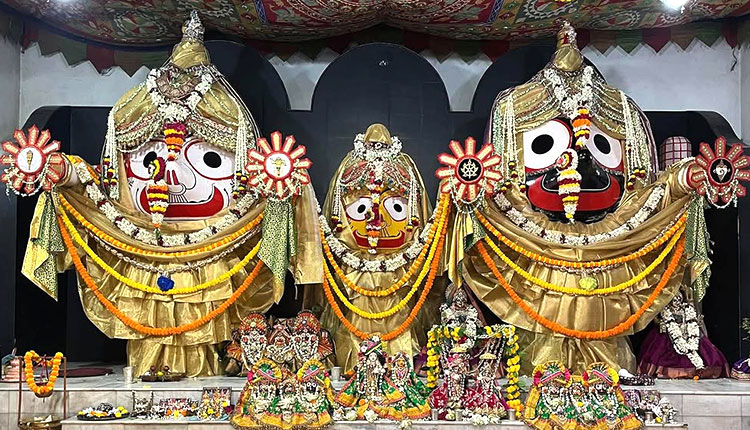
Puri: In the sacred corridors of the 12th-century Shree Jagannath Temple, a beautiful tradition unfolds every day where the deities are lovingly adorned in resplendent dresses and ornaments — a practice known as Besha.
In temple tradition, Besha signifies dress, decoration, and divine adornment. From the early morning Mangala Alati to the night Pahuda, Lord Jagannath, Lord Balabhadra, and Devi Subhadra are dressed in cotton and silk garments like Tadapa, Uttariya, and Paharana, along with exquisite gold ornaments, flowers, Tulasi leaves, sandalwood, camphor, and musk.
Significance Of Naba Joubana Besha
When we speak of the Nabajoubana Besha, it refers to the sacred youthful adornment of the entire Trinity — Lord Jagannath, Lord Balabhadra, and Devi Subhadra — the three sibling deities of the Shri Jagannath Temple. Far from being limited to one, this special Besha celebrates the rejuvenation of all three divine siblings as they regain their radiant, youthful appearance together. Ommcom News delves deep into this cherished tradition.
After spending 14 days in seclusion at the Anasara Ghara for their annual ritualistic recuperation, the sibling deities are all set to bless their devotees with a grand darshan in their resplendent Nabajoubana Besha today.
Without exaggeration we can say that the deities have shed their ailments and emerged with renewed youthful energy in the much-awaited Nabajoubana Besha after a fortnight of secluded recuperation in the Anasara Ghara. This special Besha marks their complete rejuvenation and celebrates the fresh vitality with which they will soon embark on their annual sojourn during the grand Rath Yatra on Thursday.
The holy town of Puri is buzzing with spiritual fervour as thousands of devotees have converged to witness the sacred Nabajoubana Darshan. The highlight of this divine transformation is the sacred Banakalagi or Srikumkha Sringara ritual, where the deities are meticulously repainted using natural herbal pigments. Hingula (red), Haritala (yellow), Kasturi (musk), Keshara (saffron), and Kaitha (wood apple gum) are applied with utmost devotion by the temple’s Dutta Mohapatra and Khadiprasad Daitapati servitors.
Guided strictly by the ancient palm-leaf manuscript Banaka Pothi, the servitors carefully paint the eyes, eyebrows, eyelashes, nose, and mouth of the deities. The ritual reaches its sacred climax with the painting of the eyeballs — a moment that signifies the full restoration of their youthful radiance and divine consciousness .Also known as Netra Utsav, the Nabajoubana Darshan creates an emotionally charged atmosphere as devotees catch the first glimpse of the Lords in their rejuvenated form.
This darshan not only marks the end of the Anasara period but also serves as a spiritually uplifting prelude to the world-famous Rath Yatra, during which the deities will ride their majestic chariots to the Gundicha Temple.
As the doors of the Srimandir open for this auspicious occasion, the air in Puri is filled with chants, devotion, and joy. For millions of believers, witnessing the Naba Jaubana Besha is a moment of profound connection — a divine assurance of renewed hope, energy, and blessings for the year ahead.